


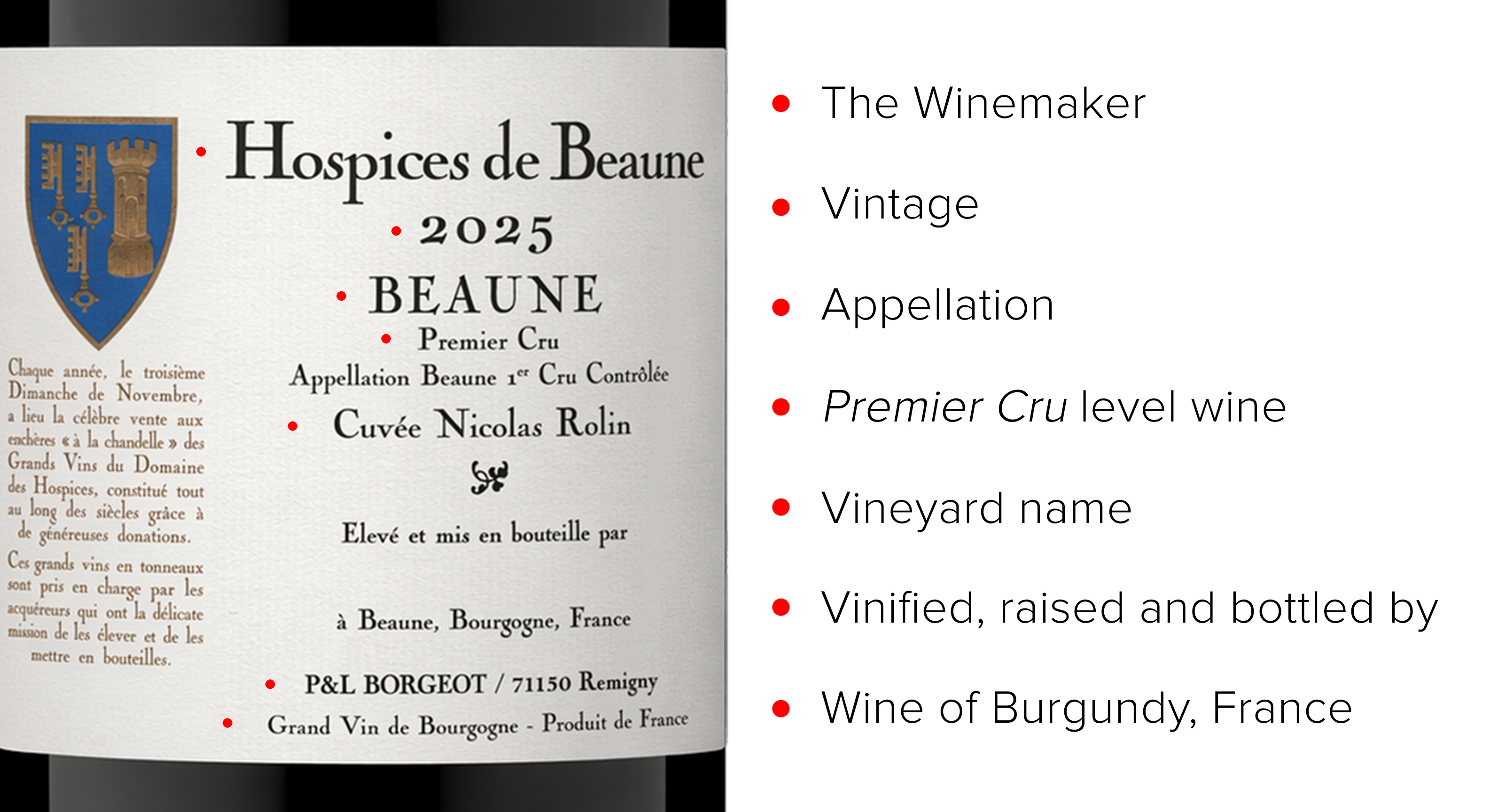
A typical example of a Burgundy wine label
Picking up a bottle of Burgundy wine for the first time can be confusing. What looks like a puzzle is actually a map: one that prioritizes place over producer, and land over brand. There is no grape variety listed; almost without exception, the grapes used are Pinot Noir and Chardonnay. The producer’s name appears in small print at the bottom. What dominates instead is a place — a village, a vineyard, a classification you may not have encountered before. This is not an oversight. It is a philosophy, one that sets the Burgundy region apart from almost every other wine region in the world.
Understanding that philosophy turns the wine label from a barrier into a map. Here is how to read a Burgundy label – and what it has to do with the wine in the bottle.
The First Thing to Know: Appellations Before Winemakers
In most wine regions, the winemaker’s name is the headline. In Burgundy, it is almost a footnote. What matters most — legally and culturally — is where the grapes were grown. This is why you will see the words “Appellation [location] Contrôlée” printed prominently on every bottle. That phrase, abbreviated to A.O.C., is the French system for guaranteeing geographic origin. It tells you, before anything else, the wine’s origin.
In Burgundy, the system of AOC wines is unusually precise and differs from other French wine. Rather than a broad regional designation, wines here are classified according to a strict hierarchy of four levels, each one more specific than the last.
The Four Levels of the Burgundy Wine Pyramid
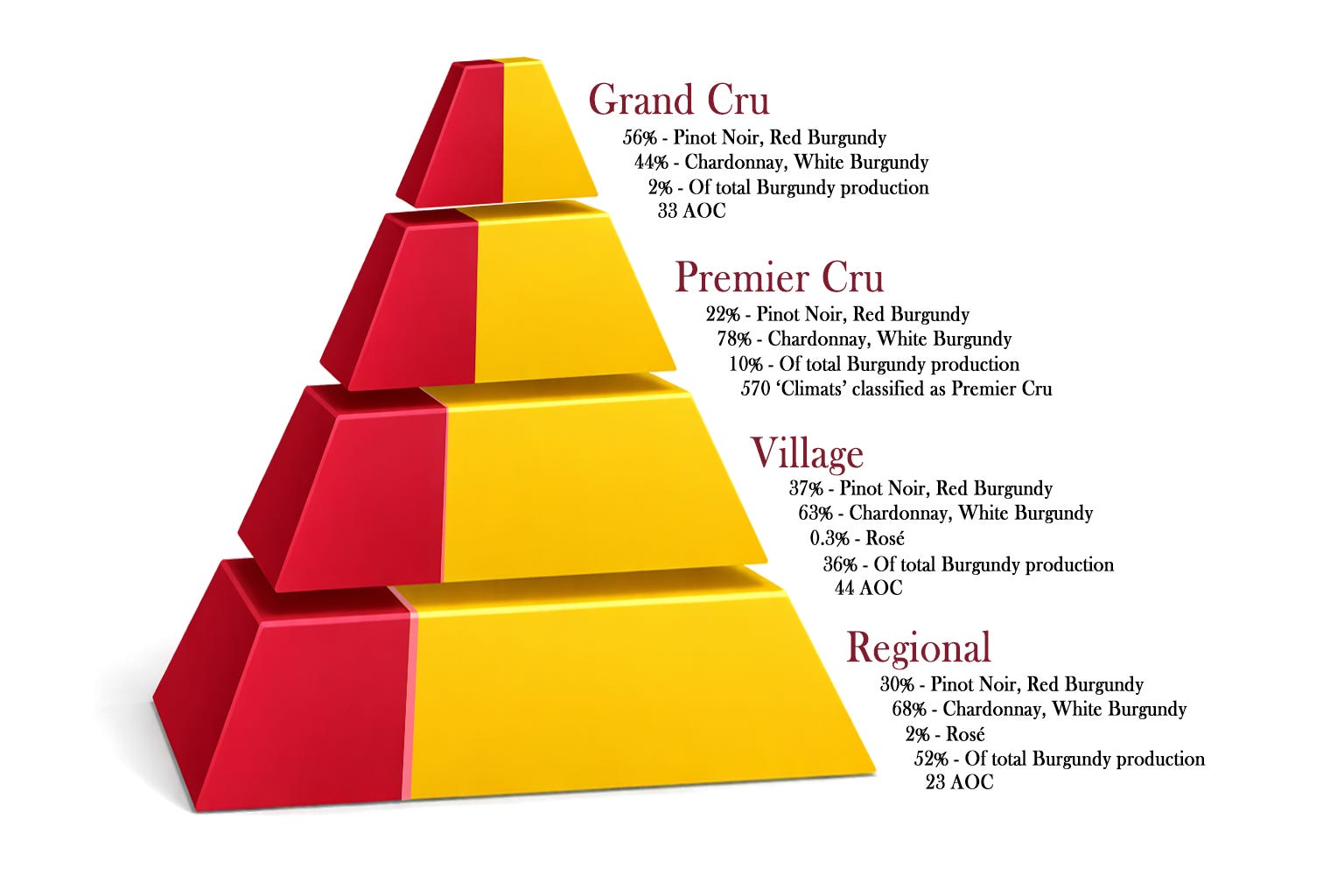
The four quality levels for AOC in Burgundy
Regional AOC Burgundy
At the base sits Bourgogne Rouge or Bourgogne Blanc. Grapes may be sourced from across the region. These wines represent around half of all Burgundy production and are often the best place to start. They are not inferior simply because they are regional; in the hands of a skilled winemaker, a Bourgogne Rouge can be deeply satisfying.
Village AOC Burgundy
A significant step up in specificity. At village level, Burgundy starts to feel personal. You’re no longer drinking ‘Burgundy’—you’re drinking Gevrey-Chambertin or Chambolle-Musigny, places with distinct personalities. Around a third of Burgundy’s output sits at this level. The village name tells you a great deal about style: village-level wine from Gevrey tends toward structure and depth; Chambolle toward perfume and elegance.
Premier Cru Burgundy
Often written as 1er Cru. These wines come from a specific named vineyard within a village, one recognised for the quality of its site - in other words, the specific terroir (soil and geology). There are hundreds of Premier Cru vineyards across Burgundy, among them Meursault, Maranges and Rully - in all regions apart from the Mâconnais in fact. The label will show the village name followed by the name of the vineyard, for example: Chambolle-Musigny Les Amoureuses, from one of the prettiest areas of the Côte de Nuits. Some appellations have a large number of Premier Crus - for example the Beaune appellation in the Côte de Beaune, with more than 40.
Grand Cru Burgundy
The top two percent. Grand Cru Burgundy vineyards stand entirely on their own name; no village designation is needed. Chambertin, Corton, Montrachet — these names appear alone on the label, without a village prefix. There are 33 Grand Cru appellations in Burgundy, and they are among the most scrutinized pieces of land in the world thanks to their superb terroir.
The Vineyard Trap Every New Burgundy Wine Buyer Falls Into
Many Burgundy villages changed their names in the early twentieth century, appending the name of their most famous vineyard to boost commercial appeal. Gevrey added Chambertin to become Gevrey-Chambertin. Vosne added Romanée to become Vosne-Romanée. This creates an important distinction that catches many buyers of Burgundy’s fine wines off guard.
A bottle labelled Gevrey-Chambertin is a village wine. A bottle labelled Chambertin is a Grand Cru. These are not the same wine, and their prices reflect that. Reading carefully — and knowing which names belong to the village and which to the vineyard — is one of the most valuable skills a Burgundy buyer can develop.
Once you learn how to read a Burgundy label in this way, things stop being confusing. It becomes a map of one of the most detailed agricultural landscapes in the world—and every bottle is a different coordinate.
Other Burgundy Wine Label Terms Worth Knowing
A few phrases appear regularly on wine labels in Burgundy and are worth recognizing. “Mis en bouteille au Domaine” means the wine was bottled by the producer who grew the grapes — a sign of the provenance of the wine. “Monopole” indicates a vineyard owned entirely by a single producer; in Burgundy this can be quite a rare occurrence, as plots are often divided across dozens of owners. “Vieilles Vignes,” meaning old vines, appears frequently but carries no legal definition; treat it as an indication of a producer’s intent rather than a guarantee of the quality of the wine.
You will also notice that Burgundy wine labels rarely mention grape variety. This is intentional. In Burgundy, red wine means the Pinot Noir grape was used and white wine means Chardonnay — with rare exceptions such as Aligoté in Bouzeron or Gamay in Beaujolais. The region assumes you already know this, or will learn quickly.
For some appellations you may see slightly different names on the label—for example in Chablis, where the entry-level wines use the prefix “Petit,” followed by the village level, then the Premier Cru and Grand Cru tiers.
Burgundy Wine Labels: A Practical Starting Point
When you next pick up a bottle and prepare to read a wine label at your local wine shop, work through it in three steps. First, find the AOC designation and identify which level of the hierarchy it occupies. Second, note whether the producer is a Domaine — an estate that grows its own grapes — or a négociant, a merchant who sources and blends from across the region. (A négociant may never own vineyards but can still produce exceptional wines by sourcing from top growers). Third, check the vintage. Burgundy is a region where the year matters enormously; conditions vary significantly from one harvest to the next.
None of this requires expertise to begin with. It requires only attention. The label is a document, and once you’re comfortable reading wine labels, every bottle tells you something before you even pull the cork.
Our sponsor burgundywine.com works with more than forty small-production domaines across all four levels of the Burgundy wine hierarchy. If you would like to explore regional, village, Premier Cru and Grand Cru wines and see how these differences play out in real wines, their wine shop is a useful place to begin. There is also a Burgundy Wine Club for like-minded enthusiasts to join, and lots of other fascinating information about winemaking and recent vintages.
This is a great guide!
What a clear and helpful post. Looking forward to reading more!