


By Dennis Sherman
Contributor to the The Burgundy Outlook
Edited by Jonathan Finch
SPONSORED LINKS
The Burgundy Outlook is an independent weekly publication managed by Editor Jonathan Finch. This specific edition was researched and written by contributor Dennis Sherman. This newsletter is distributed free to readers thanks to a commercial sponsorship from burgundywine.com. All editorial coverage, wine evaluations, and market strategies presented in this article are determined solely by the author and remain entirely independent of sponsor influence.
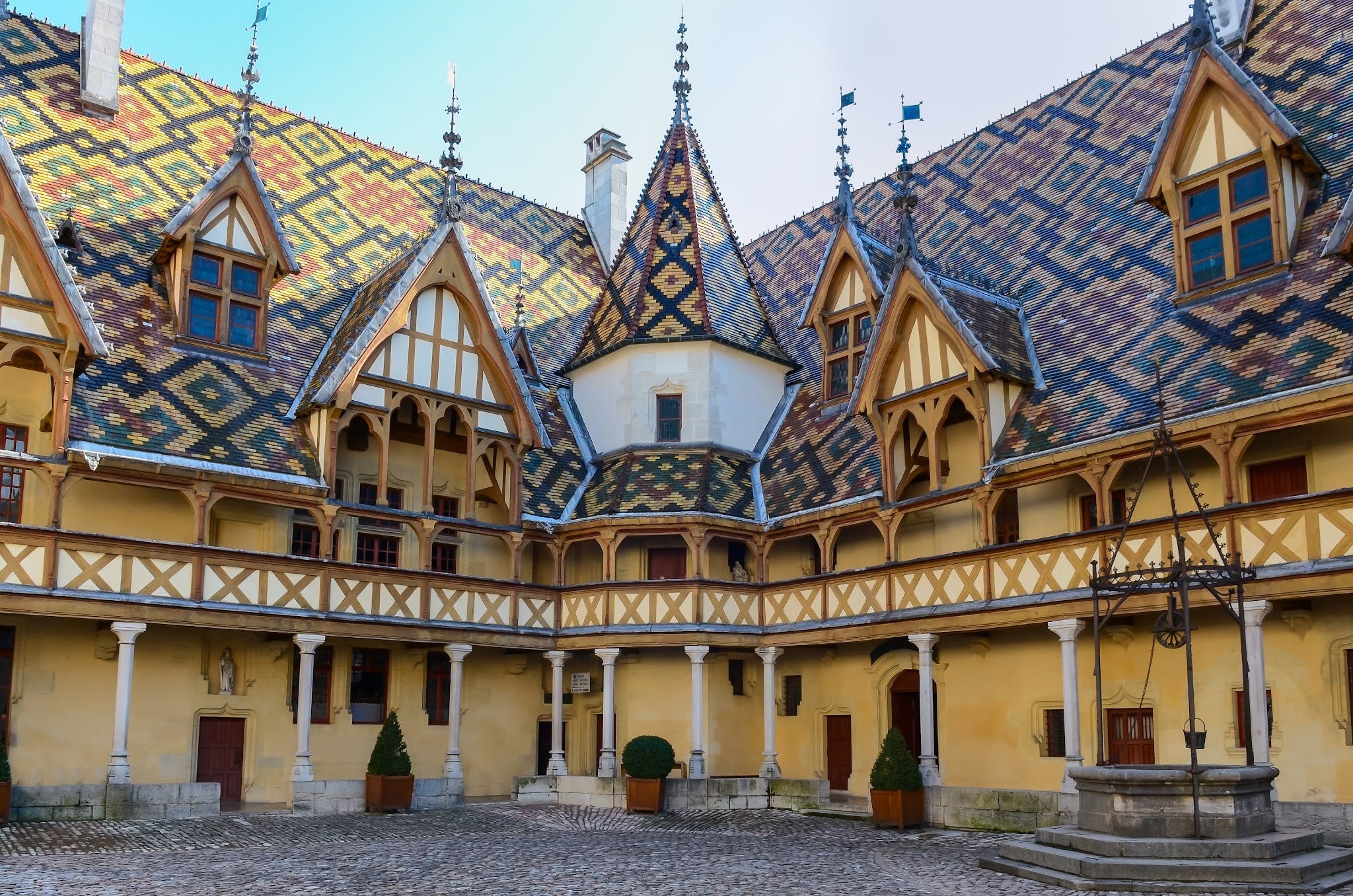
On Sunday 15 November the Hospices de Beaune holds its 166th wine sale under the Halles de Beaune, in the heart of the town of Beaune, with the first lot due under the hammer at around 2.30pm. The wines are from the 2026 vintage, so bidders will be paying for very young wine, as they do every year in this great tradition, from a crop the Hospices picked over nine days between 15 and 24 August. It is the most closely watched charity wine auction in Burgundy, and this year it arrives with a small harvest, a hot vintage and a red wine market that has been soft. Here is what to know before it starts.
Everything You Need to Know About the Hospices de Beaune Wine Auction
The history of the Hospices begins in 1443, when the Hôtel-Dieu in Beaune was founded by Nicolas Rolin, Chancellor to the Duke of Burgundy, and his wife Guigone de Salins, as a hospital for the poor. Benefactors gave it vineyards over the centuries, and the Hospices wine estate now covers about 60 hectares, mostly in the Côte de Beaune, including Premier Cru and Grand Cru parcels, certified organic since the 2024 vintage. The wines have been sold at this charity auction since 1859, on the third Sunday in November.
The money still goes to the hospital. A new 15,000 square metre building is under construction in Beaune at a cost of around €86 million, and buyers at last year’s and this year’s sales are helping to pay for it. For the wine world beyond Beaune the sale matters for another reason: it produces the first public price of the new vintage, and growers, merchants and négociants from all over the Côte d’Or watch it closely.
The sale is the centrepiece of Les Trois Glorieuses, three days of wine celebrations that begin on Saturday 14 November with a gala chapter dinner of the Confrérie des Chevaliers du Tastevin at the Château du Clos de Vougeot, and end on Monday 16 November with the Paulée de Meursault, a growers’ banquet held at the Château de Meursault, at which each guest brings bottles to share. Most of the dinners are by invitation or limited ticket. The part anyone can join is the weekend in between, when music and folk groups fill the streets of Beaune, and the Domaine des Hospices de Beaune, local wine merchants and estates across Beaune offer tastings, some of them by booking. A live broadcast is planned on a giant screen at place de la Halle, in the centre of Beaune, for anyone without a seat. For the Burgundy wine trade it is a weekend that matters more than most.
What Is Being Sold at the 2026 Burgundy Wine Auction
Sotheby’s, the auction house that runs the sale, lists around 50 cuvées. Each cuvée is sold in pièces, 228-litre casks that the Hospices equate to 288 bottles. Last year’s sale offered 552 lots: 428 casks of 34 red wines, 111 of 18 white wines, 11 of eaux-de-vie, and the charity barrel. The auction attracts bidders from around the world, and last year Sotheby’s cited record participation and showed the wines at 24 events in 17 locations, including Abu Dhabi, Bangkok and São Paulo.
The 2026 Hospices vintage is a relatively small crop at 432 barrels. Of this total there will be 348 Red and 84 White. The number of white wine barrels, at 20%, is about normal. However, unlike the similarly small crop of 2024, this low yield was caused by an early heatwave. The remaining small batches of grapes soaked up the summer sun, leading to highly concentrated, naturally rich, and high quality fruit with wines being described as having concentrated aromas and powerful tannins.
What Recent Prices of Vins Des Hospices de Beaune Suggest
Last year’s sale raised €18.8 million, the third-highest total in its history. The average price per cask rose by more than 4 per cent to about €34,000, the fifth year running above €30,000, with reds averaging €27,480 and whites €58,580. Grand Crus averaged €86,290 a cask and Premier Crus €23,180. Totals tend to follow the size of the crop. The record is €28.9 million in 2022, 2023 brought €23.3 million from 753 barrels, and 2024, a vintage with much lower yields, raised roughly €14 million.
The Hospices de Nuits-Saint-Georges sale in March, whose proceeds also go to the Hospices Civils de Beaune, gives a recent signal. It raised €1.5 million, up on 2025 but well below 2024. The Comité’s request that winemakers hold their prices this year because red wine sales are soft, hints that whites could be the stronger story in Beaune this November.
The Charity Barrel at the Hospices Auction
One cask each year, known as the Pièce de Charité or Pièce des Présidents, is sold for good causes. It is auctioned without a buyer’s premium and the whole price goes to the chosen charities, which this year work on rare diseases: DEBRA France and ARSLA. The cask is usually a Premier Cru or Grand Cru from the Hospices’ own vineyards. Last year a Pommard Premier Cru Les Rugiens made €400,000, though the record is an enormous €810,000, set in 2022 for a Corton Grand Cru.
How the Hospices de Beaune Auction Actually Works
Lots are sold in catalogue order. The buyer of the first cask in a series can take further casks from the same series at the same hammer price, and the right passes to the next bidder if they decline. Bidders register in advance with Sotheby’s and can bid in the auction room, by phone, online or by written order. Access to the auction is formally restricted, and Beaune’s tourist office describes the sale as reserved for wine professionals, although the Hospices also accept registered private buyers.
Once the hammer falls, the wine goes to a négociant-éleveur who ages it, and the bottling of Hospices wines usually follows 12 to 24 months later. A bottle bought next month will not reach its owner before late 2027.
How to Take Part in the Charity Auction Without a Paddle
Most private buyers take part through a négociant or a wine merchant, and many share a cask. One cask yields 288 bottles, so splitting it into six shares of 48 bottles lets a small group, or a merchant’s customers, buy into a single cuvée. The cost of a share is more than the hammer price. Aging and bottling, then labelling, shipping, insurance and duties, all add to it, so merchants usually agree a budget before the sale. Allocations tend to go first to established customers, which is a good reason to ask early.
On the day, three things are worth watching:
The total. It may pass last year’s €18.8 million, or it may land nearer 2024’s roughly €14 million, which was also a small vintage.
The charity barrel. Does it beat last year’s €400,000, and how close does it come to the €810,000 record?
Grand Cru casks. Last year’s average was €86,290. With fewer barrels on offer, the top cuvées will show how much demand there is for scarce, impressive wine.
What this Famous Wine Auction Tells You, and What It Does Not
A Hospices price is a signal for the whole region, and it says less about what any single bottle will cost. Buyers are paying for very young wine and for the cause, so the result is best read as a gauge of mood at the start of a vintage, and this year that vintage is small and early. We will return to what happened at the auction and what it all means in a later issue.
Suffice to say, there is something profoundly moving about the whole occasion. A hospital founded in 1443 still sells the wine from the vineyards its benefactors gave it, in the town where it began, to help pay for the care it gives today. Every bidder, whether in the room or on the phone, adds a line to a story that started nearly six centuries ago. Most of us will never raise a paddle, but it is easy to see why so many people feel they have taken part. A bottle from a Hospices cask, opened years from now, will carry the date, the town and the cause with it. That sense of belonging to something far older than ourselves is what draws people to Burgundy in the first place, and few days in the wine calendar show it as clearly as this one.
About the Author
Dennis Sherman is a Burgundy-based wine merchant and professional taster with more than 40 years of firsthand experience living and working in the region.
Featured Promotion
🍷 Participate in the Hospices de Beaune Auction
The Burgundy Outlook receives financial support from burgundywine.com to distribute this publication. At this year’s event, burgundywine.com will buy directly at the auction, allowing their clients to participate in the 2026 vintage through varying barrel share amounts.
To learn how you can secure a barrel share, view recent Hospices wines, and read detailed tasting notes, visit buy a barrel share or view recent Hospices wines with tasting notes here.
