


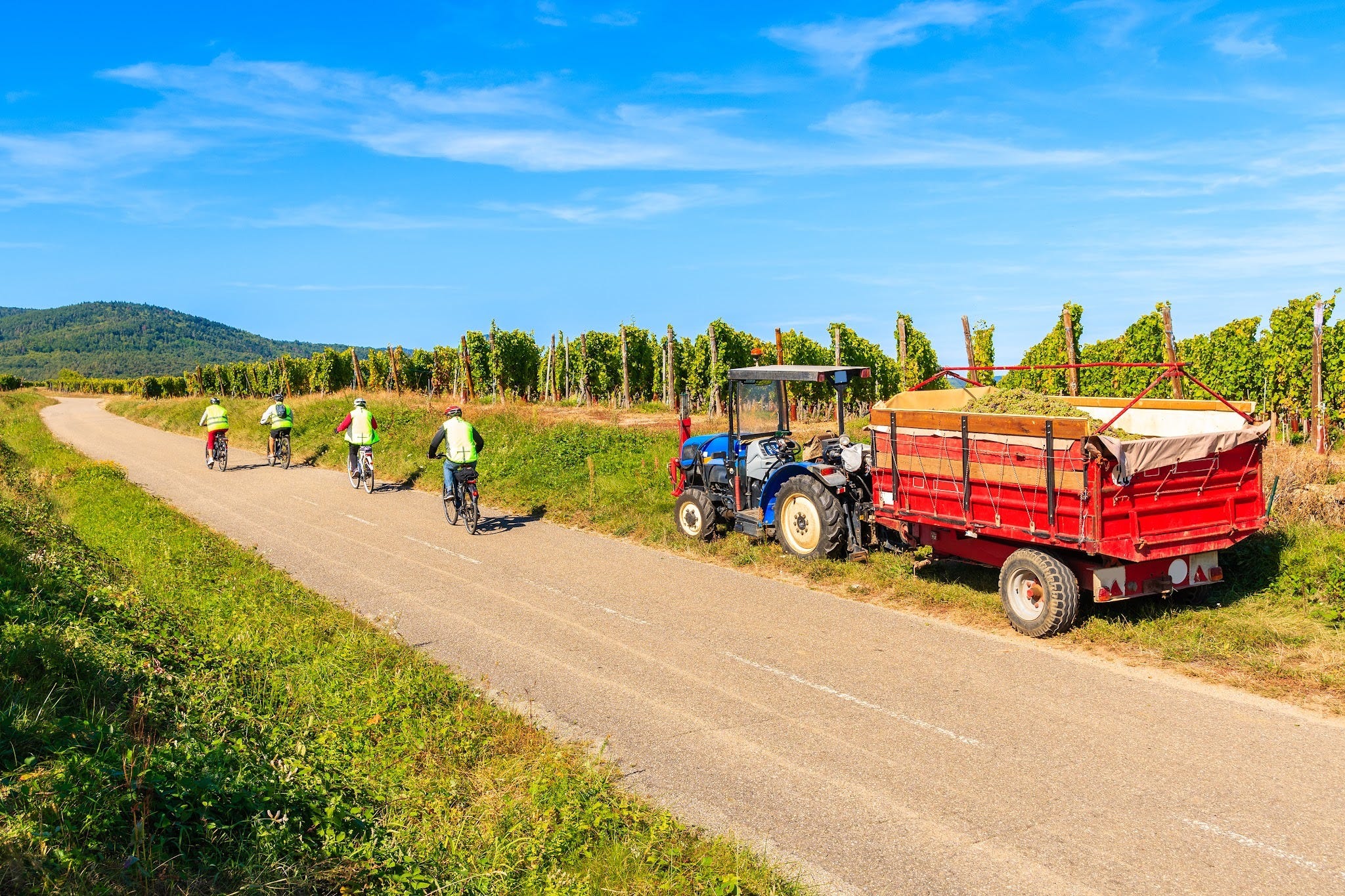
Cyclists passing by tractor with trailer during harvesting in vineyards, France
There is a particular pleasure in arriving at a vineyard on a bicycle. You have felt the slope, smelled the air, noticed how the vines change character as the geology shifts beneath you. When you finally stop and maybe do a little wine tasting, you are not a tourist consulting a map. You are someone who has just come through the landscape that made it.
Burgundy is one of the best wine regions in the world to explore by bike. The terrain is varied but manageable, the roads are quiet, and almost every charming village worth knowing about sits within comfortable biking distance of the next. There are a wide variety of cycle routes to choose from depending on your personal likes and dislikes. For example, there are miles of cycle paths to explore by the side of the Canal du Nivernais or the Canal de Bourgogne if you like waterways. Cycling along a Burgundy canal with the sun on your face, en-route to another world-class vineyard or one of the famous châteaux, is an experience that will live long in the memory.
What follows here is a practical three-day route from Dijon south to Beaune — taking in two of Burgundy’s most celebrated wine corridors for the Pinot Noir and Chardonnay grapes that Burgundy has become so famous for, and several of its most characterful places along the way.
Before Your Burgundy Bike Tour: Practical Considerations
High-quality bikes, including electric-assist models for those who prefer a more relaxed pace, are available for hire throughout the region. Electric bikes in particular have opened up Burgundy cycling to a far wider range of visitors — the gradient differences between valley floor and mid-slope vines are small but cumulative, and having the option to assist makes the difference between a tasting stop and a rest stop.
Plan your fitness level honestly before you go. The three-day route below covers approximately 100 kilometres in total, averaging around 33 kilometres per day — well within reach of a moderately active cyclist, particularly with electric assist. Pack light, carry water, and book accommodation in advance; the villages along the Côte d’Or are popular in summer and rooms in the better-placed small hotels fill quickly.
One practical note: Burgundy’s wine roads are not always clearly signed for cyclists. A downloaded offline map on your phone, or a GPS device with the bike routes pre-loaded, is strongly recommended.
Your Tour of Burgundy Cycling Itinerary: Dijon to Beaune and Beyond
Day One Route: Dijon to Nuits-Saint-Georges — The Côte de Nuits
Begin in Dijon, the northern gateway to the Burgundy wine region and a city worth arriving a day early to explore. The Palais des Ducs de Bourgogne anchors the old town; the covered market on Tuesday, Thursday, Friday and Saturday mornings is the best introduction to the region’s produce you will find anywhere. The famous Citeaux Abbey (which the cheese is named after) is a little to the south.
From Dijon, take the D122 south — known locally as the Route des Grands Crus — a road that threads through some of the most famous vineyard land in the world. Within a few kilometres you reach Marsannay-la-Côte, one of the Côte de Nuits’s quieter appellations and a good place to stop early before the more celebrated villages begin.
The route continues through Fixin and into Gevrey-Chambertin, where the church, the medieval Château de Gevrey-Chambertin, and the surrounding Premiers Crus reward a proper stop. Continue south through Morey-Saint-Denis and into Chambolle-Musigny — the contrast in atmosphere between these two villages, separated by barely two kilometres, is one of Burgundy’s minor wonders. Chambolle is quieter, more picturesque, and the vines here produce wines of unusual finesse.
End the first day in Nuits-Saint-Georges. The town has more character than its slightly industrial approach suggests, and several good restaurants clustered around the main street. It is also home to the Hospices de Nuits, whose annual spring auction, held in the cellars of the nearby Château du Clos-de-Vougeot, is one of Burgundy’s most distinctive events.
Day Two Itinerary: Nuits-Saint-Georges to Pommard — The Heart of the Côte de Beaune
The second day takes you through the most photographed stretch of Burgundy wine country. Begin with a morning visit to the Château du Clos de Vougeot, the great medieval winemaking estate that now houses the Confrérie des Chevaliers du Tastevin. The château is open to visitors and the enclosed vineyard — 50 hectares, more than 50 growers — is the most instructive illustration of Burgundy’s fragmented ownership model you will find in one place.
Continue south through Vosne-Romanée. This is not a village that announces itself loudly. The lanes are narrow, the houses modest, and the vines utterly unremarkable to look at. But Vosne-Romanée contains the most concentrated cluster of Grand Cru land in Burgundy — including Romanée-Conti, La Tâche, and Richebourg — and walking or cycling its paths gives you a sense of how intimately place and wine are connected here.
Cross into the Côte de Beaune via Ladoix-Serrigny and continue to Aloxe-Corton, whose hill of Corton — carrying Grand Cru vines on three sides — is the dominant landmark of the northern part of this region. Both red Corton and white Corton-Charlemagne are produced here; the latter, grown on the upper western slopes, is one of Burgundy’s great white wines.
End the second day in Pommard or the nearby city of Beaune itself, depending on preference. Pommard is smaller, quieter, and entirely focused on red wine; Beaune is the region’s capital and considerably more lively, with its medieval Hôtel-Dieu where the world-famous UNESCO world heritage site of the Hospices De Beaune auction is held, its network of négociant cellars open for tasting, and a good selection of restaurants.
Day Three Route: Beaune to Santenay — The Southern Côte de Beaune
The third day is the most rewarding for those drawn to white Burgundy. Heading south from Beaune, the route passes through Pommard and Volnay — two communes whose red wines embody the difference between structure and elegance as clearly as any two appellations in the region — before arriving in Meursault.
This is the village where white Burgundy becomes most immediately compelling to the broadest range of palates. The wines are richer, rounder, and more accessible than the steelier Chablis to the north, and the place itself has a relaxed, prosperous character. Several domaines here welcome visitors for tasting; a mid-morning stop at a winery is well worth planning in advance.
The route continues through Puligny-Montrachet and into Chassagne-Montrachet — places whose names have been attached to the greatest white vineyards in the world, Montrachet and Bâtard-Montrachet among them. From Chassagne the road drops gently toward your journey’s end - the town of Santenay, one of the southernmost villages in this region, and a quiet, spa-town character quite different from the communes in the countryside to the north. The Romans came here for the mineral waters; the wines produced on the slopes above — particularly the deeper, more structured reds from the Gravières Premier Cru — are still undervalued relative to their quality.
What You Can Learn from a Burgundy Wine Cycling Tour
Three days on a bicycle through the Côte d’Or teaches you something no tasting note or wine book can fully convey: that the differences between appellations are not abstract.
Cycling vacations let you feel the change in elevation, see the shift in soil color where chalk gives way to clay, notice how the vine rows are oriented differently on different slopes. By the time you taste a Chambolle next to a Gevrey, or a Meursault next to a Chablis, you understand in a physical way why they taste as they do.
Burgundy is a region that rewards attention and patience whilst you immerse yourself in its wine culture. The quiet country cycling routes of Burgundy bring something unique to your experience of it. A bicycle is, quite literally, the perfect vehicle for it.
Try These Burgundy Wines Before Visiting the Vineyard...
If you are interested in trying wines from some of these communities along this route — Chambolle-Musigny, Nuits-Saint-Georges, Meursault, Chassagne-Montrachet, Santenay and many of the other fine Pinot Noirs and Chardonnays — head over to burgundywine.com