


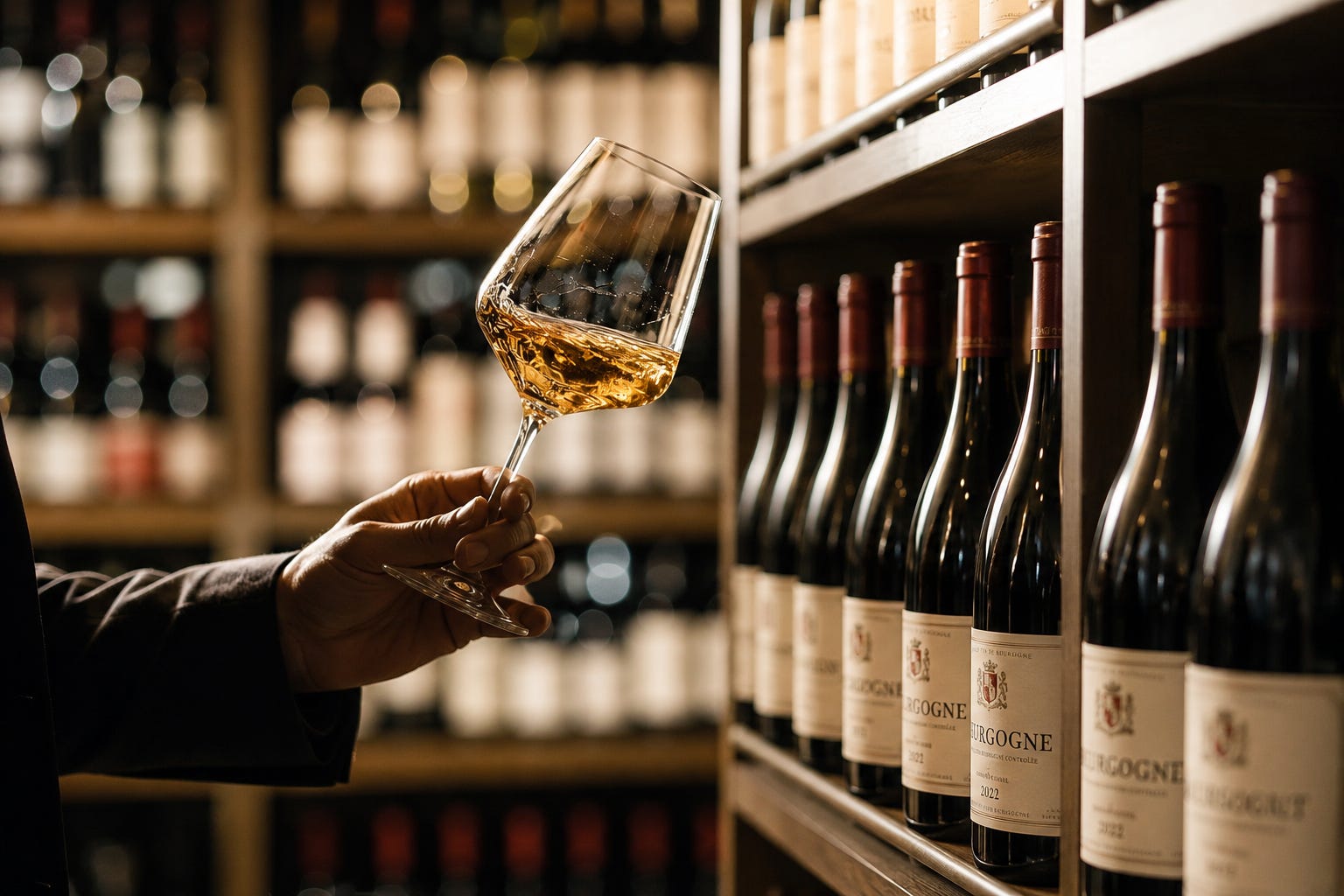
A New Perspective on Burgundy Wine Classification
Michelin’s new wine rating system, the Michelin Grape, launches on 7 July, and it has plenty of people talking. The idea is straightforward: apply the same rigour Michelin brings to restaurants to wine, judging estates against criteria such as agronomy, identity and balance. For anyone trying to make sense of an unfamiliar wine region for the first time, that kind of independent, structured benchmark is genuinely useful. It gives winegrowers and négociants a recognisable mark of quality, and gives drinkers somewhere to start.
The logo of the newly-launched Michelin Grape Guide
Yet look closer at a landscape as beautifully complex and wonderfully quirky as the Burgundy region, and a fascinating question about Burgundy’s wine classification arises. Structured tier systems offer an excellent starting framework for global exploration — but Burgundy is a landscape where standardisation tells only half the story. To truly unlock the magic of these hillsides, a different approach is required: one rooted not in global classification, but in deep, localised curation.
The Beautiful Puzzle of the Burgundy Wine Vintage
The Michelin system does an admirable job of identifying baseline excellence, particularly in honouring the domaines and winemakers who maintain high standards and deliver remarkable distinction across multiple vintages. This is an invaluable tool for finding reliable estates producing the best wines the world over.
However, seasoned Burgundy lovers know that in this particular slice of France, a challenging vintage is not a hurdle to be overcome — it is the very soul of the wine.
Natural Variance: The Unpredictable Beauty of Burgundy Wine
The variance is the virtue: a cool, rainy spring or a scorching summer completely redraws the map of Burgundy from one year to the next. Mother Nature has a hand in all wines here; it has been so throughout history, since the time of the Cistercian monks and latterly the Dukes of Burgundy.
Beyond a unified standard: a winemaker working the same plot in their vineyard might make something lean and “tightly wound” in a cooler year, then something altogether richer and more generous the next. Neither wine is the better one; they’re just what that year produced.
Grading systems generally look for consistency, which makes sense when you’re comparing thousands of estates worldwide. But that same instinct can work against a region like Burgundy, where the whole point is that no two years taste alike, despite almost all wines being dominated by just two grapes, Pinot Noir and Chardonnay. (Bourgogne Aligoté is one of the very few exceptions). A fixed rating risks setting an expectation that every bottle from a given estate should taste the same. It is one of the quiet contradictions built into any classification of Burgundy — the region rewards exactly the unpredictability a rating system is designed to iron out.
The contrast between the ripe, generous 2022s and the tighter, more structured wines of a cooler year like 2021 makes the point vividly. Two Pinot Noir wines from the same Gevrey-Chambertin vineyard, made a year apart, can taste as different from each other as a village wine does from one of the appellation’s Premier Crus. A classification tier cannot capture that. Only a relationship with the vintage — and with the winemaker who shaped it — can.
Universal Pillars vs. Local Nuance
Michelin’s evaluation relies on five universal criteria — including technical mastery and quality of agronomy — to ensure a reliable standard across all wine regions. For broad exploration, this global yardstick is genuinely helpful.
But Burgundy has never fitted neatly into a universal box. It is a region of microscopic nuance, where a single stone wall in the Côte de Beaune can separate two entirely different flavour profiles from one clos to the next — the line between a Puligny-Montrachet Chardonnay and a white wine from the hill of Corton, or the difference between a village wine and one of the region’s Premier Cru and Grand Cru wines.
A Classification System Designed for Unique Winemakers and Terroir
The human element: Burgundy’s identity is shaped by tiny, family-run domaines handed down through generations, from the deep reds of the Côte de Nuits to the racier whites further south. Their vinification practices are often deeply intuitive, sometimes defying conventional ‘technical precision’ to achieve an emotional, soul-stirring expression of their particular plot of ground — what the French call terroir.
The danger of the checklist: a generalised framework naturally favours structured consistency. In doing so, it can miss the brilliant, unconventional winemaker whose wines are wonderfully idiosyncratic, yet breathtakingly authentic. It is the same reason an appellation like Fixin — a commune with land farmed with quiet seriousness for centuries, but never fashionable — can produce a Premier Cru of real distinction while remaining almost invisible to a broad, standardised rating.
Beyond A Wine Classification System: The Case for True Curation
A Burgundy wine classification can tell a consumer that a winemaker is excellent, but it cannot tell them who that wine is for. It can’t capture the poetry of an under-the-radar village punching far above its weight in a particular year, or guide a collector to the exact bottle that aligns with their own palate and preference.
The real way to get to know Burgundy is not by working through a checklist. It comes from years spent in the local cellars, getting to know the families who run them, and learning how a winemaker’s temperament ends up in the glass. That is the approach a specialist like burgundywine.com has taken for decades: every winemaker on their list has already been vetted so carefully that, by their own measure, each one would earn a top rating.
But vintage and palate both shift the picture, which is exactly why a single score can never tell you everything. Curation gets you to the right bottle. Classification only gets you to a good one.
A Journey From Villages to Grand Crus Vineyards
Michelin’s spotlight on viticulture, and on Burgundy in particular, will be welcomed by all wine enthusiasts who care about the region. But the true joy of Burgundy, whether you are talking of village appellations or Grand Cru vineyards, will remain an intimate, unmapped journey. Alongside any scoreboard, wine lovers should seek out deep, localised expertise — and to embrace Burgundy exactly as it was meant to be experienced: authentic, unpredictable, and deeply personal.