


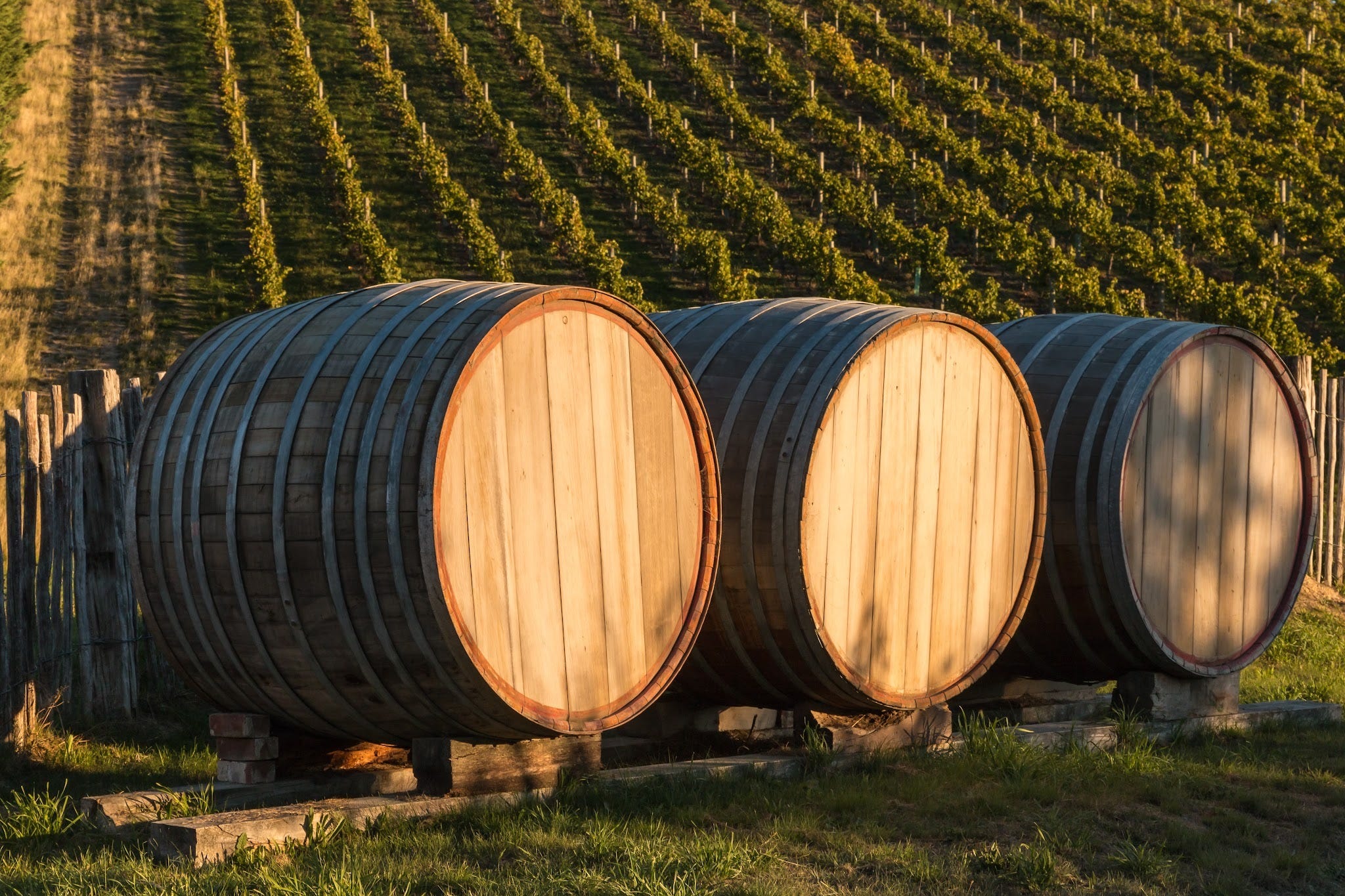
Sunlit oak barrels in a vineyard
There is a moment in every serious conversation about Burgundy when someone mentions oak, and the room divides. Oak enthusiasts reach for words like structure, complexity, and integration. Oak sceptics talk about wood overwhelming the wine, about vanilla and toast masking the terroir that Burgundy is supposed to be about. Both sides are describing real wines they have actually drunk. The disagreement is not about taste so much as about proportion — and proportion, in Burgundy, is everything.
This article is not an argument for or against oak in winemaking. It is an explanation of what oak actually does in the cellar, why Burgundy winemakers use it in the specific ways they do, and how to read into what’s inside a bottle once you know what to look for.
Understanding élevage — the French term for the ‘raising’ or ‘bringing up’ of a wine through its post-fermentation life in barrel — changes the way every Burgundy bottle comes across on the palate.
What Elevage and Oak Barrels Actually Mean for Burgundy Wine
The word élevage comes from the same French root as élever — to raise, as in raising a child. In the context of winemaking, it describes everything that happens to age wine between the end of fermentation and the moment it is bottled: the time spent in barrel or vat, the decisions made about oxygen exposure, the management of the lees (deposits of grape seeds and dead yeast), the timing of racking and fining. It is, in other words, the period in which the winemaker shapes what the wine will become, in terms of its flavors and textures.
In Burgundy, élevage typically lasts between twelve and twenty-four months, depending on the appellation, the vintage, and the winemaker’s philosophy. The most common vessel are the 228-litre Burgundy oak wine barrels, known as a pièce. These almost always use French oak — most commonly from the forests of Vosges or Tronçais — each type of oak imparting a subtly different character to the wine. American oak, widely used elsewhere in the world, is rare in Burgundy; its flavor profile — more pronounced vanilla, coconut, and sweet spice — is usually considered too assertive for the delicacy that Burgundy winemakers prize.
New Oak vs. Old Oak: A Critical Distinction in the Wine Barrel
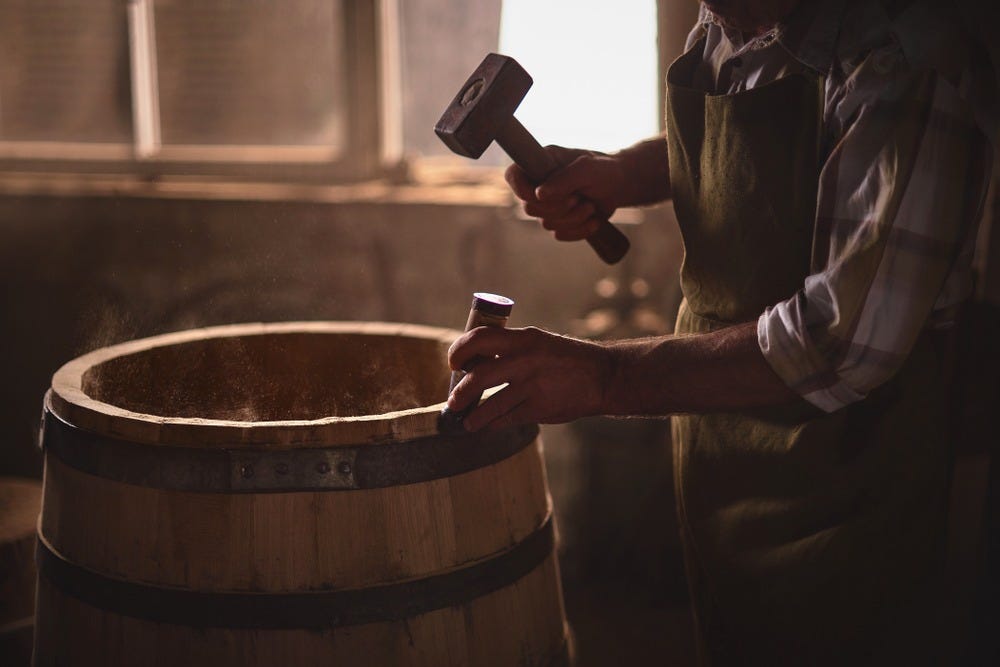
Barrel-making, or coopering, using oak and iron
The single most important decision a winemaker makes about oak is what proportion of new versus older barrels to use. A new barrel imparts more flavor compounds — vanilla, toast, cedar, spice — than one that has already held wine for a season or more. By the third or fourth use, barrel aging contributes much less flavor; its value at that point is mainly as a vessel that allows controlled, gentle oxidation.
In Burgundy, the percentage of new oak used in a wine’s élevage is one of the clearest signals of a winemaker’s stylistic intent. At the lighter end, winemakers like the Oudin sisters in Chablis use no new oak at all for their Village and Premier Cru wines, judging that the Kimmeridgian minerality of their terroir is best expressed without any wood influence. At the other end, a domaine producing rich, structured Premier Cru or Grand Cru from Gevrey might use fifty percent or more new oak, trusting that the density of the wine can absorb that influence and integrate it over years in the bottle.
Oak Aging: a Key Decision in the Winemaking Process
Most serious domaines sit somewhere between these poles in terms of their relationship with oak in their wines. Domaine Bouton in Saint-Aubin uses twenty to thirty percent new oak for whites, allowing the lees to buffer the wood influence while building texture through batonnage. Domaine Jean Féry uses approximately fifty percent new for whites, trusting the freshness of the Hautes-Côtes fruit to hold its own against the barrel’s contribution. Domaine Borgeot in Santenay uses around twenty-five percent new across their range — enough to add structure and length, but not enough to obscure the mineral signature of the Chassagne and Santenay terroir.
The key principle in all of these decisions is the same: the oak should serve the wine, not define it. When a taster can identify new oak as the dominant character in a glass of Burgundy, something has probably gone wrong. The goal is integration — a state in which the oak’s contribution is felt as texture and depth rather than heard as flavor.
What Oak Does to the Chardonnay Grape & White Burgundy Wine
The effect of oak on Chardonnay is usually more immediately perceptible than its effect on Pinot Noir, which is one reason the debate about oak tends to centre on white Burgundy. A Chablis aged entirely in stainless steel or older neutral vessels is a wine of pure, linear fruit and mineral precision. The same vineyard vinified in new oak barrels would be a fundamentally different experience — richer, rounder, with a layer of spice and toast that either enhances or obscures, depending on how much new wood was used.
The process that typically accompanies oak aging in white Burgundy is malolactic fermentation — a secondary fermentation in which malic acid (crisp, apple-like, tart) is converted by bacteria into lactic acid (softer, creamier, more rounded). Most white Burgundies outside of Chablis undergo malolactic fermentation as a matter of course. The result is wines with a softer acidity and a broader mid-palate — what drinkers often describe as the buttery or creamy quality associated with Meursault and its neighbours.
Batonnage — the regular stirring of the lees that will settle at the bottom of the wine barrel — is a further tool in the white Burgundy winemaker’s kit. Stirring the lees back into suspension adds texture, weight, and a particular kind of savouriness that can resemble toasted almonds or brioche. Used judiciously, it is one of the most effective ways of building complexity in a white Burgundy without increasing the proportion of new oak. The best Meursault winemakers are, among other things, very skilled batonneurs.
How Oak Affects the Pinot Noir Grape and Red Burgundy Wine
Pinot Noir, with its naturally fine tannins and relatively low pigmentation, interacts with oak differently from the thick-skinned, tannic varieties of Bordeaux or the Rhône. The risk with new oak in red Burgundy is not bitterness so much as dominance — a situation where the toasty, spiced character of the barrel overpowers the delicate cherry, raspberry, and floral notes that make Pinot Noir from the Côte de Nuits so singular.
Winemakers who use significant proportions of new oak for red Burgundy are typically relying on the density of their fruit to absorb it. A Grand Cru from a warm vintage — with deep color, concentrated fruit, and firm structure — can accommodate fifty percent new and emerge from the barrel with the wood fully integrated. The same percentage applied to a village-level wine from a lighter vintage would produce something that tastes primarily of barrel.
The length of élevage matters as much as the oak percentage for reds. Domaine Joliet in Fixin, whose wines are known for their precision and ageing potential, uses a two-year élevage in oak — longer than many domaines, and a reflection of their confidence in the structure of the Clos de la Perrière fruit to evolve slowly and reward patience. The reds undergo extended vinification of up to twenty days before the wine even reaches the barrel, building the tannin framework that allows a long élevage to refine rather than overwhelm.
For domaines whose philosophy leans toward minimal intervention, the approach is different but equally deliberate. Pierre Naigeon in Gevrey-Chambertin uses no fining or filtration, allowing the wine to clarify naturally during élevage. The result is wines with a depth and texture that filtered wines rarely achieve — but also wines that require time in the glass before they open fully.
How to Taste Élevage in the Glass
Once you know what to look for, élevage becomes readable in the glass. The most accessible signals are on the nose and the mid-palate.
New oak announces itself through vanilla, toast, cedar, coconut — in whites — or through spice, coffee, and a warming sweetness in reds. In younger wines, these notes can be quite forward. In wines that have had time in the bottle, they integrate into the background, adding depth without leading the conversation.
Lees ageing and batonnage show up as texture and weight — a broader, more generous mid-palate in whites, with notes of toasted bread, almonds, or cream. This is distinct from oak flavor; it is more about mouthfeel than aroma.
Malolactic fermentation is detectable in reduced acidity and a softer, rounder impression overall. A white Burgundy that has not undergone malolactic fermentation will feel more precise and mineral at the edges; one that has will feel broader and more enveloping. Both can be correct — it depends entirely on what the winemaker was aiming for and what the site is capable of expressing.
The most instructive exercise is to taste two wines from the same vintage and appellation — one made with significant new oak, one with minimal or none. The terroir will be broadly similar; what differs is the signature of the élevage. With a little practice, reading that signature becomes second nature, and every bottle of Burgundy becomes a more complete experience.
Brilliant. Great read. I know this is an odd question but do you work in English or French? To have this depth of knowledge and relationships in Burgundy, I would hazard you’re perfectly bilangue.