


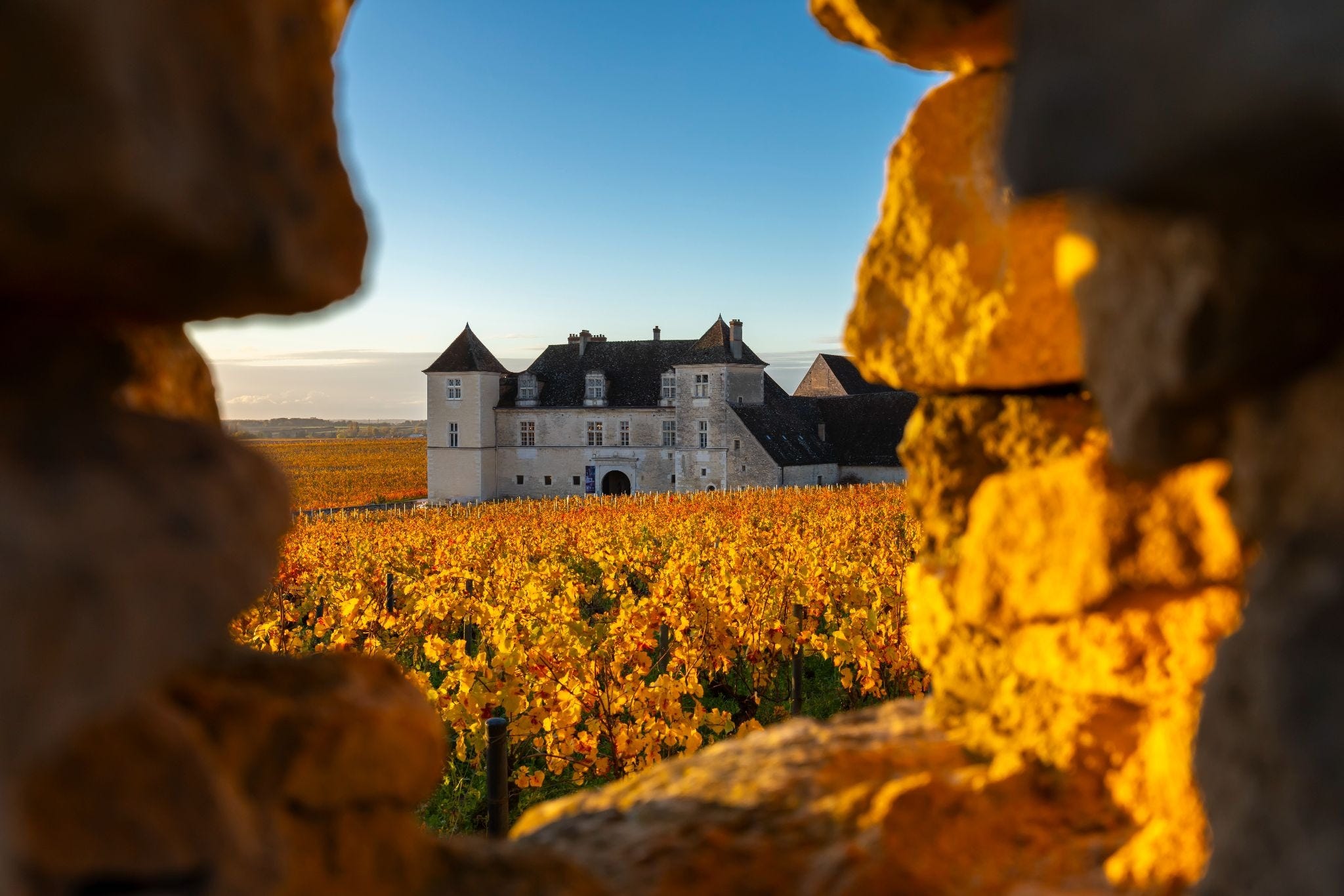
Travel through Burgundy and discover the enchanting Château du Clos-de-Vougeot
Burgundy rewards the unhurried visitor. Arrive with a week, a loose plan, and the willingness to be led by the landscape, and you will find a region that reveals itself in layers — first through its wines, then through its history, then through its food, and finally through the people who have chosen to spend their lives making something remarkable in a particular piece of ground.
Seven days is enough time to travel the full length of the region, from the cool limestone valleys of Chablis in the north to the warm, generous Chardonnay country of the Mâconnais in the south. It is not quite enough time to see everything, but it’s more than enough time to fall in love with the place and improve your wine knowledge in the most enjoyable way.
A Burgundy Wine Travel Itinerary for Wine Lovers
Here we present a practical Burgundy road trip itinerary, built for wine enthusiasts who want to understand Burgundy as a whole — not just the Côte d’Or, which is where most wine tours begin and end, but the full sweep of a region whose diversity and depth are most apparent when you travel it from end to end.
Day 1: Arrive in Dijon — The Gateway to Burgundy and Its Wine
Begin in Dijon, the northern capital of Burgundy and the natural gateway to the region from Paris. The TGV from Paris Gare de Lyon takes about an hour and a half; arriving by early afternoon leaves the rest of the day for the city itself.
Dijon rewards time spent on foot. The Palais des Ducs de Bourgogne (Palace of the Dukes of Burgundy) anchors the old town and its tower offers a view over the terracotta rooftops that gives you an immediate sense of the city’s scale and history. Built by the powerful dukes of Burgundy who once ruled much of medieval Europe, it now houses the Musée des Beaux-Arts, one of France’s finest regional art museums and well worth an hour of your first afternoon. The surrounding central area is dense with medieval and Renaissance buildings, and the city’s culinary tradition — it styles itself the International City of Gastronomy and Wine — means that dinner on the first night can set a high bar for everything that follows. Dijon mustard, as any local will be quick to point out, was originally made with verjus rather than vinegar — grape juice, appropriately enough, at the heart of the city’s most famous condiment.
If you arrive on a Tuesday, Thursday, Friday or Saturday morning, a visit to the covered market at Les Halles is essential. This is the best single introduction to what Burgundy produces — not just wine, but the cheeses, the charcuterie, the snails, the farmhouse mustards, the river fish — that you will find anywhere in the region.
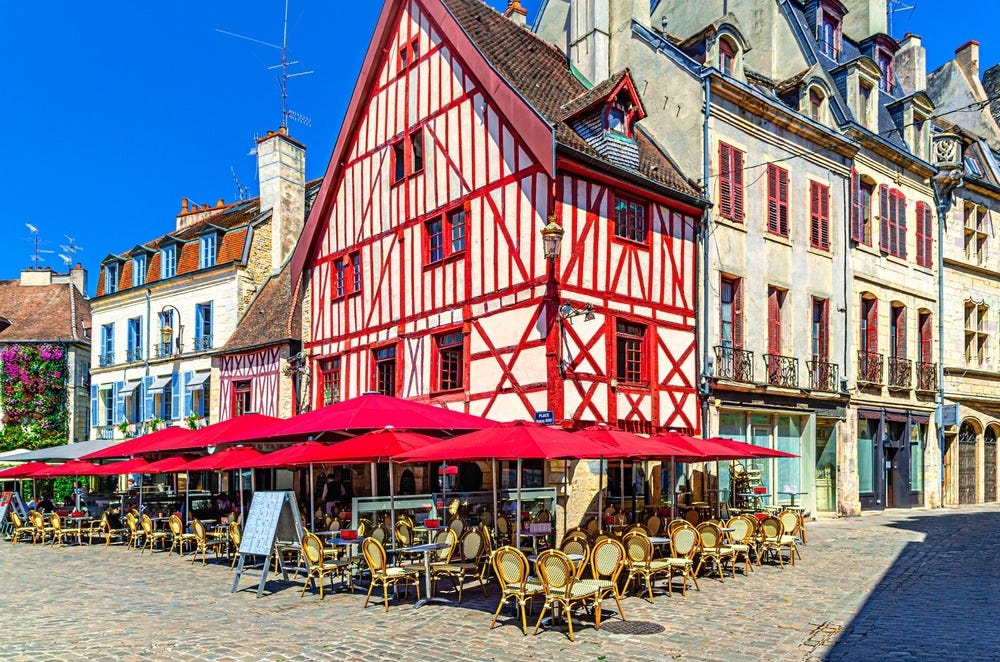
A café street scene in Dijon, Burgundy’s most northern city
Day 2: The Côte de Nuits — Gevrey to Nuits-Saint-Georges
Leave Dijon south on the D122 — the Route des Grands Crus — and within a few kilometres the city falls away and some of the finest vineyards in Burgundy begin. This road trip into the heart of Burgundy wine country is arguably the most celebrated wine route in the world. Drive slowly. The names on the roadside signs — Chambertin, Clos de Bèze, Bonnes-Mares, Romanée-Conti — are the names on the finest bottles in the best cellars in the world.
Marsannay-la-Côte is the first village of the Côte de Nuits proper, and worth a brief stop before the more celebrated names begin. Fixin follows, then Gevrey-Chambertin — the largest village in the Côte de Nuits region of Burgundy, its medieval château visible from the road, its Premier Cru vineyards climbing the hillside behind the village. Stop here for mid-morning tastings if you can arrange them in advance; Gevrey is where Pinot Noir announces its most structured, age-worthy character.
Continue through Morey-Saint-Denis — quieter, often overlooked, producing wines that balance the perfume of Chambolle with the structure of Gevrey — and into Chambolle-Musigny itself. The contrast between these two villages, separated by barely two kilometres of road, is one of Burgundy’s most instructive experiences. Chambolle is the more delicate, the more aromatic, the one whose wines are most often described in terms of lace and violet. A tasting in both villages on the same morning brings the comparison to life vividly.
End the day in Nuits-Saint-Georges. The town has character beyond its wine reputation — a lively main street, good restaurants, and a market on Friday mornings that is worth planning around. This is also where the Hospices de Nuits is based, whose annual charitable wine auction in the cellars of the nearby Château du Clos-de-Vougeot is one of the most atmospheric events on the Burgundy calendar.
Day 3: Village of Vougeot, Vosne-Romanée and the Heart of the Côte
A short morning drive north from Nuits brings you to the Château du Clos de Vougeot, the great medieval winemaking estate that now houses the Confrérie des Chevaliers du Tastevin (the historic society that exists to protect and promote Burgundy wine in the world). The château is open to visitors and the enclosed vineyard — 50 hectares, more than 50 domaines with parcels — is the most instructive illustration of Burgundy’s fragmented ownership model you will find in one place. They offer memorable wine tasting sessions here in some of the finest Burgundian surroundings imaginable. An hour here, walking the perimeter and reading the map of owners, teaches you something that no book quite manages to convey.
From Vougeot, continue south through Vosne-Romanée. The lanes are narrow, the houses modest, the vineyards utterly unremarkable to look at. Yet within these 230 hectares sits the most concentrated cluster of Grand Cru land in Burgundy: Romanée-Conti, La Tâche, Richebourg, La Romanée, Romanée-Saint-Vivant, Grands Échezeaux. Walking the paths between these parcels is a particular kind of wine pilgrimage, and one that costs nothing.
The afternoon is well spent in Beaune, the commercial and cultural heart of Burgundy wine. The Hôtel-Dieu — the medieval hospital where the Hospices de Beaune auction is held each November, and a UNESCO World Heritage site — is the city’s most dramatic landmark, its bright roof tiles the most photographed image in the region. The city’s network of négociant cellars, many open for tasting and some extending several floors underground, provides an afternoon’s worth of exploration on its own.
Day 4: The Côte de Beaune — Corton to Santenay
The fourth day follows the white wine road south from Beaune — the spiritual capital of Burgundy wine, and the sequence of villages that produces Burgundy’s most celebrated Chardonnays. Begin with a brief detour north to Aloxe-Corton and the hill of Corton, the dominant landmark of the northern Côte de Beaune, whose Grand Cru vineyards wrap three sides of the hill. Corton-Charlemagne — grown on the upper western slopes where legend holds that Charlemagne himself planted the first vines — is one of the great white French wines and still significantly underrated relative to its southern peers.
From Beaune, drive south through Pommard and Volnay — two villages whose contrasting characters are immediately legible in their wines. Pommard is firm, muscular, built for time; Volnay is lighter, more perfumed, almost feminine in the best sense. A glass of each, ideally from the same vintage, is one of the most useful tasting exercises in Burgundy.
Meursault is the destination for the white wine enthusiast. This is where Chardonnay becomes most immediately compelling to the broadest range of palates: richer, rounder, and more generous than the mineral Chablis to the north, with a texture and weight that makes the wines deeply satisfying with food. Several domaines welcome visitors; book in advance, particularly in summer. Continue through Puligny-Montrachet and Chassagne-Montrachet — whose shared hillside carries Le Montrachet, Bâtard-Montrachet, and their neighbouring Grand Crus — before ending the day in the quiet spa town of Santenay, where the Romans came for the mineral waters and Gravières Premier Cru wines are still undervalued.
Day 5: The Morvan — An Itinerary for Burgundy’s Interior
Wine is not all that Burgundy is. Day five is a deliberate departure — a day in Burgundy spent away from the vine-covered limestone slopes, heading west into the Morvan National Park — a granite massif of forest, river valleys, and granite peaks rising to 900 metres that covers 280,000 hectares across four of Burgundy’s départements. The Morvan is where Burgundians themselves go when they want to walk, cycle, and breathe air that does not smell of cellars.
The park’s eco-museum complex, spread across several themed houses — including the House of Wine and Barrel-Making in Ouroux-en-Morvan — gives a different angle on the region’s relationship with wine. Natural products from the park — honey, wild berries, the region’s celebrated Charolais beef — appear on the menus of the small restaurants in its villages. This is Burgundy at its most rural and most genuinely French, a long way from the wine tourism circuit.
Autun, on the southern edge of the Morvan, makes for an excellent afternoon stop. One of the most charming towns in all of Burgundy, it preserves remarkable Roman architecture — an ancient theatre, the Porte Saint-André city gate, the Saint-Lazare Cathedral with its extraordinary Romanesque sculpture — alongside a relaxed provincial character that makes it easy to spend several hours simply walking its streets. The commune of Couches, a short drive south, sits within the Autun arrondissement and is home to some quietly serious winemaking in the limestone hills above the Chalonnaise.
Day 6: The Mâconnais — Pouilly-Fuissé and the Southern Whites
Return to wine country for the sixth day, heading south into the Mâconnais — the warmest and most generous of Burgundy’s wine regions, where Chardonnay ripens more fully and the wines carry a richness and accessibility that makes them the most immediately appealing in the region for many first-time visitors.
Mâcon itself is worth a morning: two cathedrals, a lively riverside market town character, and a food and wine scene that punches well above the city’s modest size. The chocolate specialty of the town — Bouchons Mâconnais, made with Marc de Bourgogne liqueur — is either an excellent discovery or a step too far, depending on your relationship with digestifs.
The afternoon belongs to Pouilly-Fuissé. The twin limestone rock formations of Solutré and Vergisson — the defining visual landmarks of southern Burgundy, their silhouettes visible for miles across the plain — are worth climbing as much as visiting. The view from the top of the rock of Solutré extends on a clear day to the Alps. At its foot, the villages of Pouilly-Fuissé produce white wines that received Premier Cru classification in 2020, a recognition long overdue for a region that had been producing serious Chardonnay for generations without the formal acknowledgement. Domaine du Château de Vergisson, whose Premier Cru vines are planted at the base of the rock of Vergisson, produces wines that make the case for the appellation as convincingly as any.
Day 7: Chablis — The Northern Counterpoint of Burgundy Wine
The final day requires either a morning drive north or a strategic reversal of the itinerary, but the effort is worth it. Chablis is located around 100 kilometres north of Dijon, in the valley of the river Serein, closer to Paris than to Beaune and further removed in character from the Côte d’Or than the distance alone suggests.
This is where the itinerary comes full circle in the most instructive way possible. After six days of limestone-rich, sun-warmed Burgundy — the generous reds of the Côte de Nuits, the broad whites of Meursault, the rich Chardonnays of the Mâconnais — Chablis arrives as a counterargument. The wines here are cool, precise, and mineral in a way that the southern appellations simply cannot replicate. The Kimmeridgian limestone that underlies the vineyard soil — 150 million years old, full of fossilised oyster shells — gives the wines a saline, almost marine quality that is unlike anything you have tasted in the previous six days.
Visit a Premier Cru or Grand Cru domaine in the morning — Domaine Oudin’s Vaugiraut Premier Cru is an ideal introduction — before the drive back to Paris in the afternoon. The wines will taste different now from how they would have tasted a week ago. That is the point of travelling a wine region in full: what you learn by moving through it changes what you find in the glass.
A week in this part of the world, following a well-planned Burgundy itinerary, is not just about ticking off “bucket list” items. Most visitors find it’s actually the beginning of a much longer relationship with a place that reveals itself gradually, and rewards every return. The wines you open over the following months will taste different once you have been where they come from.
I love the ambition to treat Burgundy as more than the Côte d’Or. The route itself made me pause, though: ending in Chablis after the Mâconnais feels like a fairly punishing final transfer. I think I’d begin in Chablis from Paris, continue through Dijon and the Côte, and finish farther south, possibly departing through Lyon. You lose Chablis as the final counterargument, but gain an itinerary that feels more like travel and less like backtracking. Either way, seeing the distances and landscapes in person really does change what you find in the glass afterward. I may have to test this version myself!
Can you give more recommendations for winery visits?