


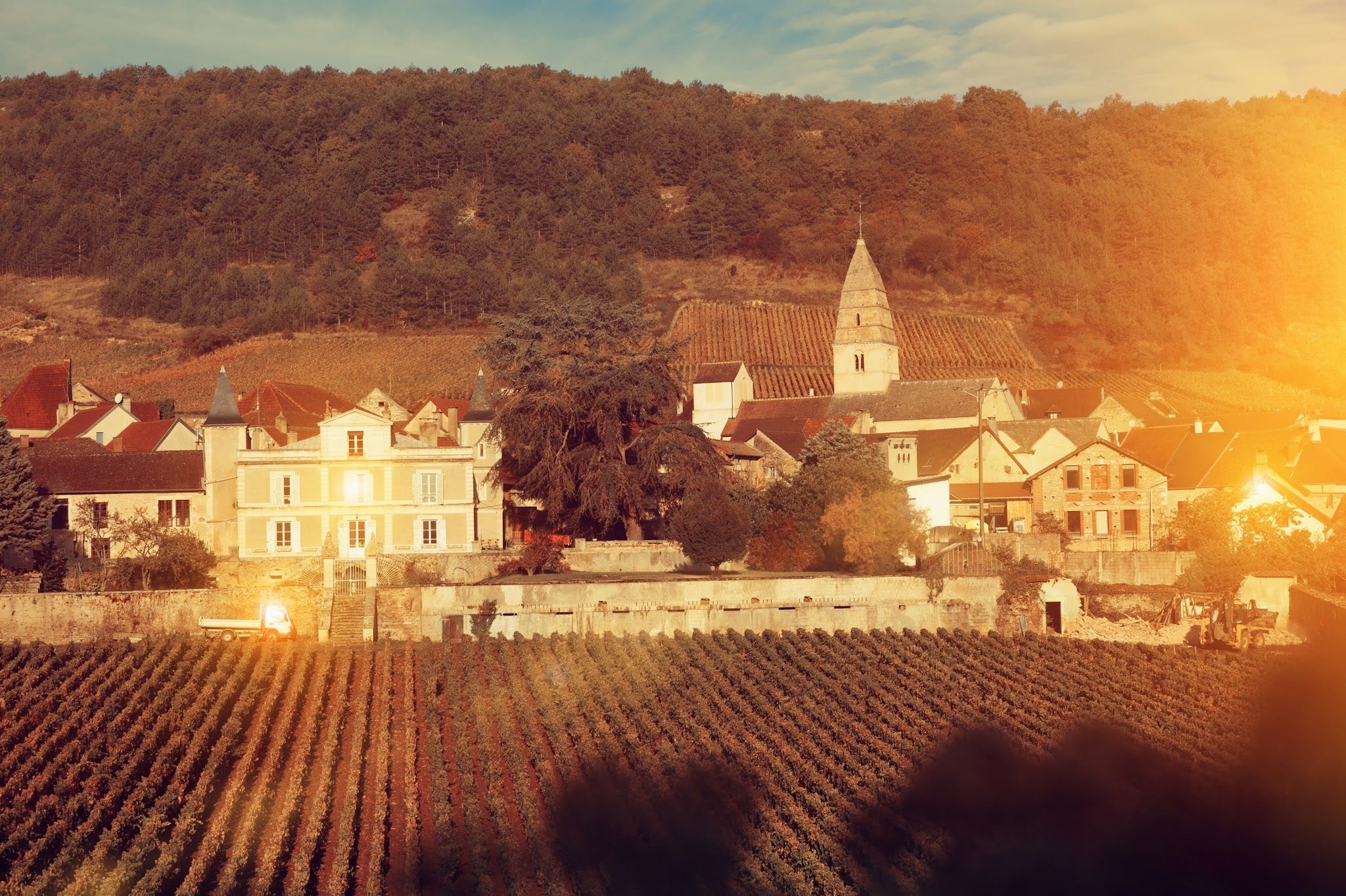
Saint-Aubin on a sunny day in Burgundy
Walk into most wine shops in 2026 and you’re likely to order Burgundy the way almost everyone does: by village, by vintage, by whichever recognisable name is printed largest on the label. It feels like a reasonable approach, and it’s one most wine writing still quietly encourages. It is also, more often than not, backwards — and it is a habit that has quietly benefited one part of the Burgundy wine trade more than any other for the better part of two centuries.
Here is the strategy that changes that, and why it is not the one most people reach for first.
The System That Still Shapes How You Shop
For most of Burgundy’s modern history, the négociant was the dominant route to market. A merchant would buy grapes or finished wine from many different small growers across an appellation, blend it into a consistent house style, and sell it under the merchant’s own name rather than the growers’. Four leading wine houses in particular built their reputations this way and still dominate a huge share of the Burgundy wine business sold worldwide: Louis Latour, Louis Jadot, Maison Albert Bichot, and Bouchard Père & Fils — the kind of names that regularly top wine and spirits trade publications and awards lists, and several of which also own historic château estates that add further prestige to their house names. Their names are the ones most likely to appear on a restaurant wine list or a supermarket shelf, precisely because they are the names built for recognition at scale.
That system is not dishonest, and the wine is often perfectly good. But it was built to sell a consistent, market-pleasing style under one memorable name — not to showcase the particular character of one small parcel of vines, farmed by one family, in one specific way. And because those merchant names are the easiest thing to remember and the easiest thing to find, most buyers default to them without ever looking past the name in large type.
What ‘Shopping Backwards’ Actually Looks Like
What happens here is that customers choose a bottle because the village name is famous, the vintage got good press, and the label carries a name they vaguely recognise — without ever checking who actually grew the grapes and made the decisions in the cellar, or reading past the headline tasting notes to see whose hands the wine actually passed through, and what that terroir tasted like in their care. It is buying an address without asking who lives there.
This matters more in Burgundy than almost anywhere else in the wine world, because the region’s defining feature is fragmentation. A single appellation can be farmed by dozens of different domaines, each making genuinely different wine from parcels a few rows apart. Two bottles of the same village, the same vintage, can taste like entirely different wines depending on whose hands the grapes passed through — and the merchant name on the label tells you almost nothing about that.
Why This Habit Suits the Fine Wine Market Négociants Just Fine
A more recent development has softened this picture somewhat: the growth of the négociant-éleveur model — merchants who now grow a meaningful share of their own fruit alongside what they buy, blurring the old line between merchant and domaine. As of 2025, several of the largest négociant-éleveur houses make wines from well over half their own estate fruit, a shift that has only accelerated in recent vintages. Even so, the underlying incentive has not changed. A house built on a consistent, recognisable style benefits every time a buyer chooses on brand recognition rather than asking a harder question: which specific grower farmed this wine, and does their name actually appear anywhere on the bottle?
Buyers who never ask that question are, in effect, the ideal customer for a system built on broad recognition rather than specific provenance. It is not a conspiracy. It’s simply a wine industry business model that works best when the second name on the label — the one in smaller print, if it appears at all — goes unread.
The Domaine-First Wine Buying Strategy
The alternative is straightforward, even if it takes slightly more effort than reaching for a familiar name. Look past the merchant or the village first, and find the specific domaine — the small, often family-run estate that grew the grapes and made the wine under its own name, usually printed in far smaller type than the appellation itself. Then follow that name, rather than the village, when you are choosing what to buy next, whether you are buying a bottle that’s ready to drink tonight or committing to a case en primeur, years before it’s even bottled.
The value case for doing this is significant. A Capitain-Gagnerot Corton-Charlemagne — a blanc built from Chardonnay grown a few rows from the celebrated Coche-Dury bottling of the same wine — is priced at a fraction of what Coche-Dury commands, not because the wine is meaningfully worse, but because the domaine has never chased the recognition. A Domaine Jean Féry Puligny-Montrachet from a winemaker living quietly between Nuits-Saint-Georges and Beaune offers much of the richness and complexity of the far more sought-after Leflaive Clavoillon, at a considerably more agreeable price.
Fixin, farmed by domaines like Domaine Joliet on soils barely distinguishable from neighbouring Gevrey-Chambertin, has made international headlines for exactly this gap between reputation and quality. The same principle holds whether you’re shopping at village level or across the finest crus, and it isn’t unique to Burgundy — something similar plays out in Napa Valley, where a handful of famous names can just as easily overshadow smaller, equally serious wineries nearby.
Another Way of Buying: Getting to Know the Winery
Read the small print. The domaine name is usually the least prominent thing on a Burgundy label, precisely because the region has always weighted place above person. Find it anyway.
Look for ‘mis en bouteille au Domaine.’ This phrase confirms the wine was bottled by the same estate that grew the grapes — a direct line of provenance that a négociant blend, by definition, cannot offer in the same way.
Follow the domaine, not just the village. Once you find a small domaine whose winemakers you genuinely trust, look for their bottlings across other appellations and investigate their track record. A winemaker’s judgement tends to travel with them from vineyard to vineyard far more reliably than a village name alone ever will.
Read a dedicated wine blog or two, and don’t overlook a good online wine merchant. A handful of independent writers and specialist online wine shops publish detailed profiles of individual domaines that never make it into mainstream coverage — exactly the kind of research that makes the domaine-first approach practical.
Lean on a specialist who has already done the legwork. Thirty years of relationships with small Burgundy domaines is not something you can replicate from a shop shelf, or even from an afternoon in a merchant’s tasting room. A curator who has spent decades getting to know individual growers, doing tastings, learning about the terroirs, working more like fine wine traders than a typical high-street shop, has effectively already applied this strategy on your behalf. You could also consider joining a dedicated wine club to take your interest further.
Future Growth: Why This Is Worth the Extra Ten Minutes
None of this requires rejecting negociant wine outright, and plenty of it is genuinely well made. But defaulting to it, purely because the name is easier to recognise, means missing the part of Burgundy that makes the region worth following in the first place: small, specific, human-scale winemaking that a broad merchant blend was never built to capture.
Building that kind of wine intelligence — knowing the grower, not just the label — is not complicated, and it’s part of your future growth as an enthusiast. But it’s the strategy that most buyers never quite get around to.
If this article has you wanting to shop by domaine rather than by village, burgundywine.com is built around exactly that approach. Rather than leaning on the big négociant names, our team has spent over three decades building direct relationships with small, family-run domaines across Burgundy, and you can browse the winemakers behind our wines to find the name behind the label, often at a fraction of the price of its more famous neighbours.