


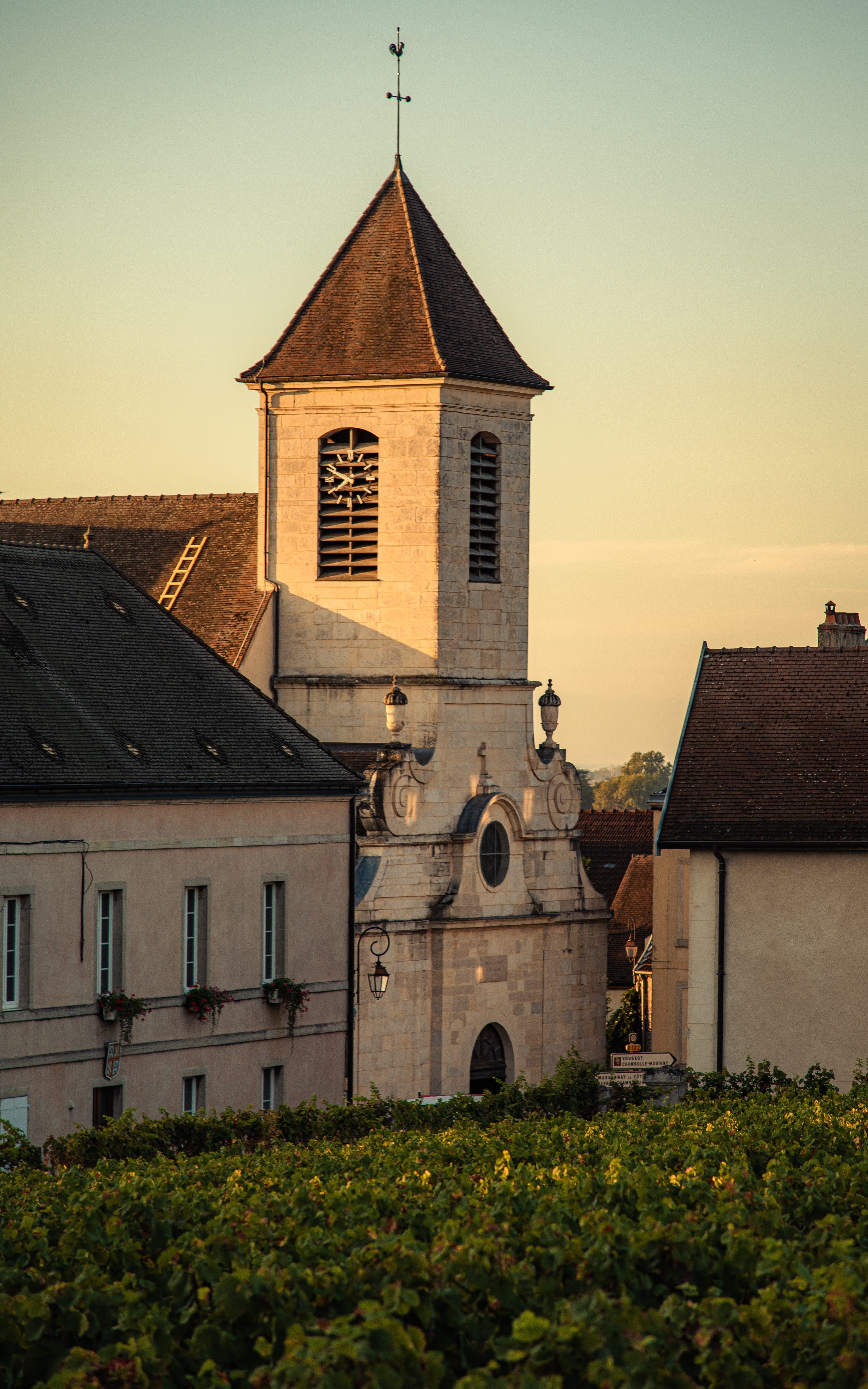
Sunrise in Morey-Saint-Denis, Burgundy, France, Cote d'Or
Ask a casual Burgundy drinker to name the villages of the Côte de Nuits, and Morey-Saint-Denis is rarely the first name that comes to mind. Gevrey-Chambertin gets there first, with its reputation for power and structure. Chambolle-Musigny follows close behind, celebrated for perfume and delicacy. Morey sits quietly between the two — and has done for centuries — producing wines that, quality for quality, are among the best-kept secrets in all of Burgundy.
Morey-Saint-Denis: Between Two Giants in the Côte de Nuits
Morey-Saint-Denis takes its name from the priory of Saint-Denis-de-Vergy, and its position on the map has shaped its identity as much as its soil has. To the north sits Gevrey-Chambertin, long associated with structured, powerful reds — wines said to have been a favourite of Napoleon himself. To the south sits Chambolle-Musigny, whose wines lean toward the aromatic and the delicate. Morey sits squarely in between, and its wines reflect that position almost too neatly: they combine the dark fruit and firm structure associated with Gevrey with the aromatic lift more often linked to Chambolle.
The result is Pinot Noir that feels grounded yet expressive — serious without being forbidding, even in youth. Tasted alongside its two more famous neighbours, Morey often acts as the village that explains them both: drink a Gevrey, a Morey, and a Chambolle side by side, and the path of the Côte de Nuits becomes far easier to trace.
A Wine Village of the Côte de Nuits That Lacks Nothing
The nineteenth-century Burgundian wine writer Dr Lavalle, whose classification of local terroirs remains influential to this day, wrote of Morey that ‘it can be said that it lacks nothing.’ The numbers back him up. More than half of the land in this small commune is dedicated to Premier Cru and Grand Cru vineyards — 20 Premier Cru vineyards (climats) and five Grand Crus — the highest proportion of high-quality land anywhere in the Cote de Nuits. Total production runs to a little over 270,000 bottles a year, the great majority of it red wine.
The five Grand Crus — Clos de la Roche, Clos Saint-Denis, Clos des Lambrays, Clos de Tart, and a small portion of Bonnes-Mares shared with Chambolle — are where Morey’s reputation, such as it is, tends to concentrate. Clos de la Roche and Clos Saint-Denis in particular can produce wines of genuine power and complexity, built on dark and red fruit in equal measure, yet balanced in a way that keeps them from ever feeling too tannin-heavy.
But it is at Premier Cru level that Morey’s value case is strongest. Cru vineyards such as Clos des Ormes — named for the elm trees that once grew there — and Les Façonnières sit immediately below the Grand Cru vineyards on the same slope, the terroir sharing much of the same limestone and exposure, at a fraction of the price. These are wines built to reward a few years in the cellar, rather than ones to open the moment they arrive. Because Morey has never carried the cachet of Gevrey or Chambolle, land here has historically cost as little as a quarter of what it commands in the neighbouring villages — a gap in reputation that has not been matched by any comparable gap in quality.
What to Look For in This Burgundy Wine Appellation
At Grand Cru level: A Clos Saint-Denis from one of the leading winemakers here - Domaine Marchand-Tawse - shows the wild, earthy power the appellation is capable of with its Grand Cru classifications, tempered by real balance — the kind of wine that makes the case for Morey’s Grand Crus standing comfortably alongside their more famous neighbours.
At Premier Cru level: the same domaine’s Morey-Saint-Denis 1er Cru ‘Millandes’, planted just below Clos de la Roche, offers a black cherry bouquet and a long, elegant finish. Their ‘Clos des Ormes’ carries a bouquet of Christmas spice and glazed cherry that makes it a natural choice for a special occasion. Then there is the Domaine Marchand Frères’ Façonnières, from one of the best-situated Premier Cru parcels in the appellation, built from fifty-year-old vines and vinified with a seriousness that would not be out of place at Grand Cru level. These are some of the more coveted wines to come out of Morey at Premier Cru level — arguably some of the best wine the appellation produces outside its five Grand Crus.
A very small amount of white wines is also made in Morey, most notably from the Premier Cru climat of Monts Luisants, where old Aligoté vines share the slope with a little Chardonnay — an intriguing footnote in a village otherwise built almost entirely on red.
For everyday drinking: Domaine Marchand Frères’ Morey-Saint-Denis Vieilles Vignes and Domaine Jean Féry’s village-level Morey both offer real character without Premier Cru pricing — the Jean Féry bottling in particular shows the black fruit and fine-tannined freshness that is typical of the appellation’s mineral, balanced style.
The Wolves of Morey-Saint-Denis
Every Burgundy village seems to carry a legend, and Morey’s is one of the region’s better ones. The village emblem shows two running wolves — an image with a story attached that is equal parts folklore and dry village humour.
Around a thousand years ago, so the story goes, a famine struck the region and the neighbouring village of Saint-Philibert lost a valuable cow. When questioned, the people of Morey denied any knowledge of it. Later, the bones of a cow turned up in the nearby woods, and the villagers offered only one explanation, delivered with a knowing glint: ‘We know nothing — but there are wolves in the area.’
The glint has never quite left the village. These days it applies less to missing livestock and more to the wines themselves — quietly excellent, snapped up quickly, and rarely by anyone who wandered in by accident. Usually, it is thirsty customers doing the taking, rather than hungry wolves. But the sense of a village that keeps its best secrets of its wine production close remains exactly the same.
Why the Morey Appellation and Terroir Rewards Attention Now
Value in Burgundy rarely announces itself. It tends to sit quietly in the villages that never developed the marketing story of their neighbours, waiting for drinkers willing to look past the more famous name on the label. Morey-Saint-Denis is as clear a case of this as the Côte de Nuits has to offer: a village with more high-classification vineyard land than almost anywhere else in this wine region, wines that borrow the best qualities of Gevrey and Chambolle without fully mimicking either, and pricing that has still not entirely caught up with the quality in the glass.
For a drinker trying to understand what the Côte de Nuits is actually doing — rather than simply which names to chase — Morey is not a compromise between its two famous neighbours. It is the village that explains them both.
Morey as the village that explains its two neighbors is such a useful way to frame it. I also love that the value proposition here seems to come from reputation lagging behind quality rather than quality being compromised. Now I want to taste Gevrey, Morey, and Chambolle side by side and trace that progression for myself.