


The classification pyramid that governs Burgundy today — regional, village, Premier Cru, Grand Cru — can feel like a modern invention: a bureaucratic system, tidy and official, stamped onto the landscape by committee. It’s really nothing of the sort.
Vines have grown on these slopes of the Côte d’Or for thousands of years of history, stretching back to Roman times — but the specific hierarchy that shapes every bottle you buy was not designed; it was discovered, over roughly a thousand years, by three groups of people who had almost nothing in common except an obsession with the same patch of ground: monks, dukes, and, eventually, revolutionaries, each leaving their mark on the Burgundian wines we drink today.
Understanding how they shaped Burgundy is not simply a history lesson. It explains why the region looks and tastes the way it does today — why a wall can matter more than a name, why some villages carry two names hyphenated together, and why a single vineyard can have fifty different owners.
The Monks: Pioneers of Burgundy Wine and Terroir
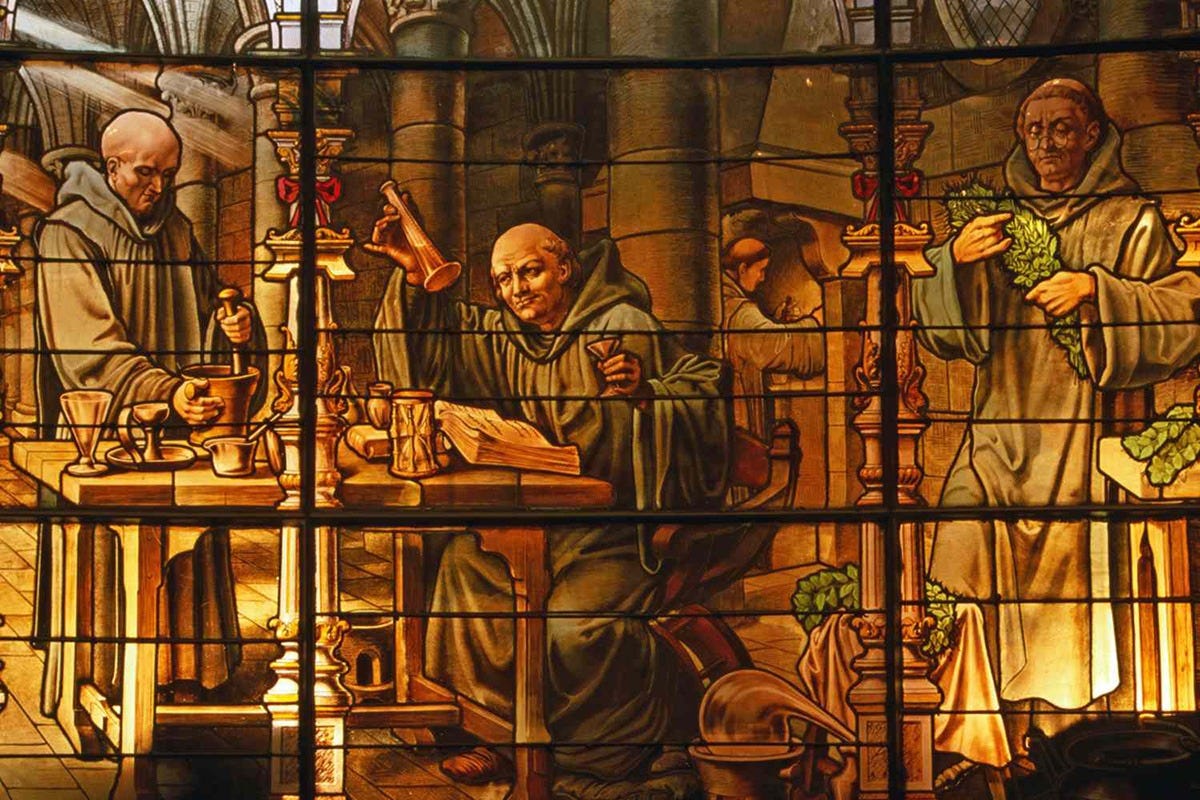
Long before anyone used the word terroir to denote soil and geology, the monks of Burgundy were mapping it — learning, plot by plot, exactly where Pinot Noir and Chardonnay performed best. The great monastic orders — first the Benedictines around Mâcon, then the powerful Benedictine abbey of Cluny and the Cistercians across the Côte de Nuits, Côte de Beaune, Chalonnaise and Mâconnais — held land granted to them by the local nobility, and set about tending it with a patience that only a religious institution operating across generations could sustain.
The Cistercian monks of Abbey de Cîteaux developed the estate now known as Clos de Vougeot, these patient monks working the land over some two centuries after establishing themselves nearby. Elsewhere, viticulture introduced by monks near the commune of Couches dates back as far as the year 731, and monks developed a reputation for Chardonnay across the Côte de Beaune every bit as strong as the one they built for Pinot Noir further north.
What made them so effective was not piety alone: they had time, continuity, cool stone cellars, and no shareholders demanding a return by harvest’s end. Wine was made first for the communion mass — a direct, doctrinal link to the blood of Christ — but the surplus built reputations that spread across Europe.
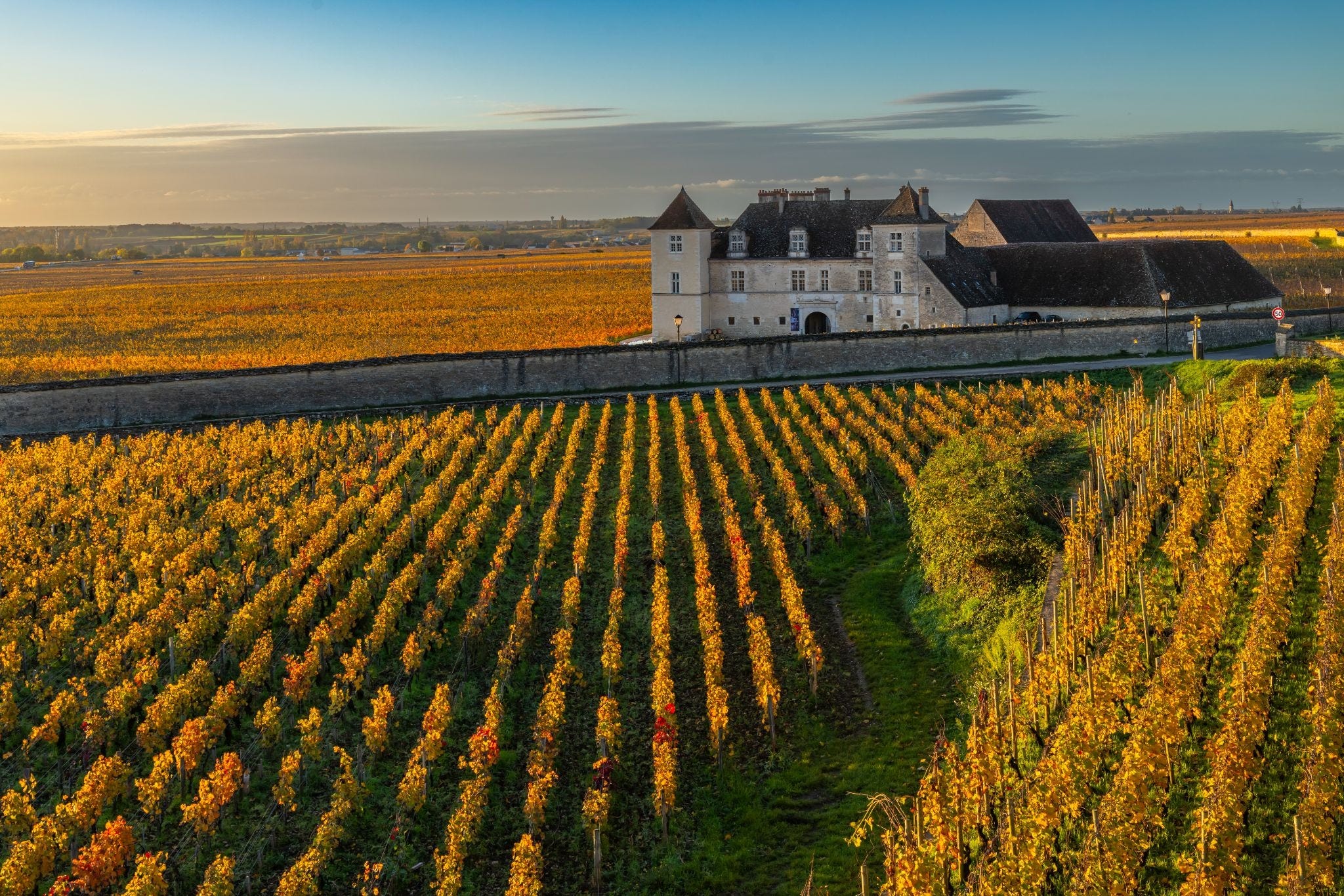
The Clos de Vougeot and its vineyards in autumn
It was this patient, plot-by-plot observation that gave rise to the idea of the climat — a single, named parcel of land whose character was understood to be genuinely distinct from the parcel beside it. Thousands of these climats still exist today, and many carry names with monastic origins.
Gevrey-Chambertin owes its most famous vineyard to a monk named Bertin, whose particularly good field became known as the Champ de Bertin — shortened, over centuries, to Chambertin. The neighbouring Clos de Bèze traces to a vineyard gifted to the monastery at Bèze. Even today, opening a bottle from either vineyard means drinking from land a winemaking monk first identified as exceptional, centuries before anyone thought to write the fact down.
The same is true further south in Meursault, where monastic cultivation of Chardonnay laid the groundwork for what is now considered one of Burgundy’s greatest white wine villages. Further north, the monks of the abbey of Pontigny did much the same for Chablis, tending vines on the Kimmeridgian slopes that still define the appellation today.
The Dukes: Turning Wine into Power
From the fourteenth century, a new set of hands took hold of Burgundy’s vineyards: the Valois Dukes of Burgundy, a line of rulers whose names — Philip the Bold, John the Fearless, Philip the Good, Charles the Bold — read like a checklist of medieval virtues. Under their rule in the Middle Ages, wine stopped being solely a matter of monastic devotion and became something closer to a political asset: a gift for foreign dignitaries, a symbol of Burgundian wealth and taste, a tool of soft power in a Europe where the Dukes of Burgundy briefly rivalled French kings in influence.
Philip the Bold left the most direct mark on the vineyard map still visible today. In 1395, he didn't just pass a law, he launched the medieval equivalent of a corporate purge. He declared the high-yielding Gamay grape to be 'vile and injurious,' banishing it to south of Macon. Effectively he outlawed it overnight to protect his luxury Pinot Noir brand. If you drink Beaujolais today, you are drinking the produce of a 600-year-old underground resistance movement that defied a ducal decree.
Philip the Good’s chancellor, Nicolas Rolin, founded the Hôtel-Dieu in Beaune in 1443 — the charitable hospital now known as the Hospices de Beaune, whose annual wine auction remains one of the most visible living links between ducal Burgundy and the region’s present. The line of the Dukes ended abruptly in 1477, when Charles the Bold was killed attempting to expand Burgundian territory near Nancy — but by then, wine had already become inseparable from Burgundian power and prestige.
A Wine Revolution: Fragmentation and the Rise of Vineyard and Village
For centuries, ownership of Burgundy’s best vineyards remained concentrated in the hands of the church and the nobility. Outside the region, almost no one knew the names of the villages or the people actually making the wine — it was sold, largely anonymously, through merchants in Beaune and Nuits. Two names carried the region’s reputation: Chambertin and Montrachet.
The French Revolution changed all of that at a stroke. Church and noble land was seized and redistributed, and the inheritance laws that followed — codified in the Napoleonic Code of 1804, which required property to be divided equally among heirs rather than passed whole to a single successor — fragmented the great vineyards into an ever-growing number of small parcels and proprietors. This is the origin of the extraordinary ownership structure that still defines Burgundy: the 50-hectare Clos de Vougeot, tended today by more than fifty separate domaines, is the clearest surviving example of a pattern repeated across the region.
What emerged from that fragmentation was competition — and, eventually, marketing. As the number of proprietors multiplied, villages that had never previously enjoyed much individual reputation looked for a way to distinguish themselves. The solution, adopted across the nineteenth and early twentieth centuries, was to append the name of the village’s most famous vineyard to the village’s own name. Puligny became Puligny-Montrachet. Gevrey became Gevrey-Chambertin, formalising the connection in 1847. Nuits became Nuits-Saint-Georges. The hyphenated village name, so distinctive to Burgundy today, is not an ancient tradition — it is a piece of nineteenth-century branding, however elegantly it has aged.
The AOC System: Formalising What the Monks Had Learned About Terroir
By the early twentieth century, Burgundy’s reputation had outpaced any formal system for protecting it. Wines were mislabelled, boundaries were disputed, and the piecemeal ownership left by the Revolution created endless opportunity for confusion. The Appellation d’Origine Contrôlée system, established in the 1930s, was the modern answer — a legal framework mapping regional, village, Premier Cru and Grand Cru status onto boundaries that, in most cases, the monks had already identified as meaningfully distinct many centuries earlier.
Put simply, the AOC pyramid didn’t invent Burgundy’s hierarchy of quality, but rather it formalised what was already agreed. Monks had been reaching the same conclusions about which rows of vines mattered for centuries before anyone decided to make it official. Likewise, consumers had been noticing the difference between one climat and the next long before there was a certificate to confirm they were right.
What This History of Burgundy Means for the Glass in Front of You
None of this is trivia. It explains why buying a bottle of Burgundy today feels like navigating a beautiful but frustrating minefield. When you look at a label and see a confusing mess of tiny parcels, hyphenated names, and competing producers, you aren't simply looking at modern bureaucratic clutter. You’re looking at a living map drawn by medieval monks, weaponised by powerful dukes, and shattered by French revolutionaries. You aren't just drinking fermented juice; you are drinking a thousand years of political ambition and patience.
The extraordinary fragmentation of ownership — the reason a single appellation can contain dozens of different domaines, each making a slightly different wine from land a few metres apart — traces back to a revolution that never set out to reshape a wine region, but did so anyway. It is, in miniature, the whole of Burgundy’s wine history — and it is a large part of why the wines this history produced are among the most genuinely complex wines in the world. It is no accident that the same climats first mapped by monks were added to the UNESCO World Heritage list in 2015 — official recognition, six centuries later, of a judgement the region had already made for itself.
Tying Up Loose Threads: the Wonder of the Clos de Vougeot
The Confrérie des Chevaliers du Tastevin, founded in 1934 and still based at the Château du Clos de Vougeot, is perhaps the tidiest symbol of how these threads meet. A brotherhood dedicated to promoting Burgundy wine, meeting on monastic ground first cultivated by Cistercian monks, inside a château built during the age of the Dukes, continuing a tradition of ceremony and stewardship that is genuinely unbroken across nine centuries.
Very few wine regions anywhere can make that claim — and fewer still can prove it, glass in hand, on the same ground where it began.
The monks were mapping a climate that no longer exists. Plots that earned their rank by ripening reliably in a cool era are now the fastest to ripen, and higher, thinner sites that used to be a bad bet get more interesting every vintage. That observation was empirical for a thousand years and has been appellation law since 1936, and appellation boundaries do not get redrawn when the growing season changes.
Burgundy starts to make a lot more sense once you realize the complexity isn’t just terroir. It’s terroir plus politics, inheritance and a thousand years of history all piled onto the same few slopes. Which also explains why learning it can feel mildly punitive haha.