


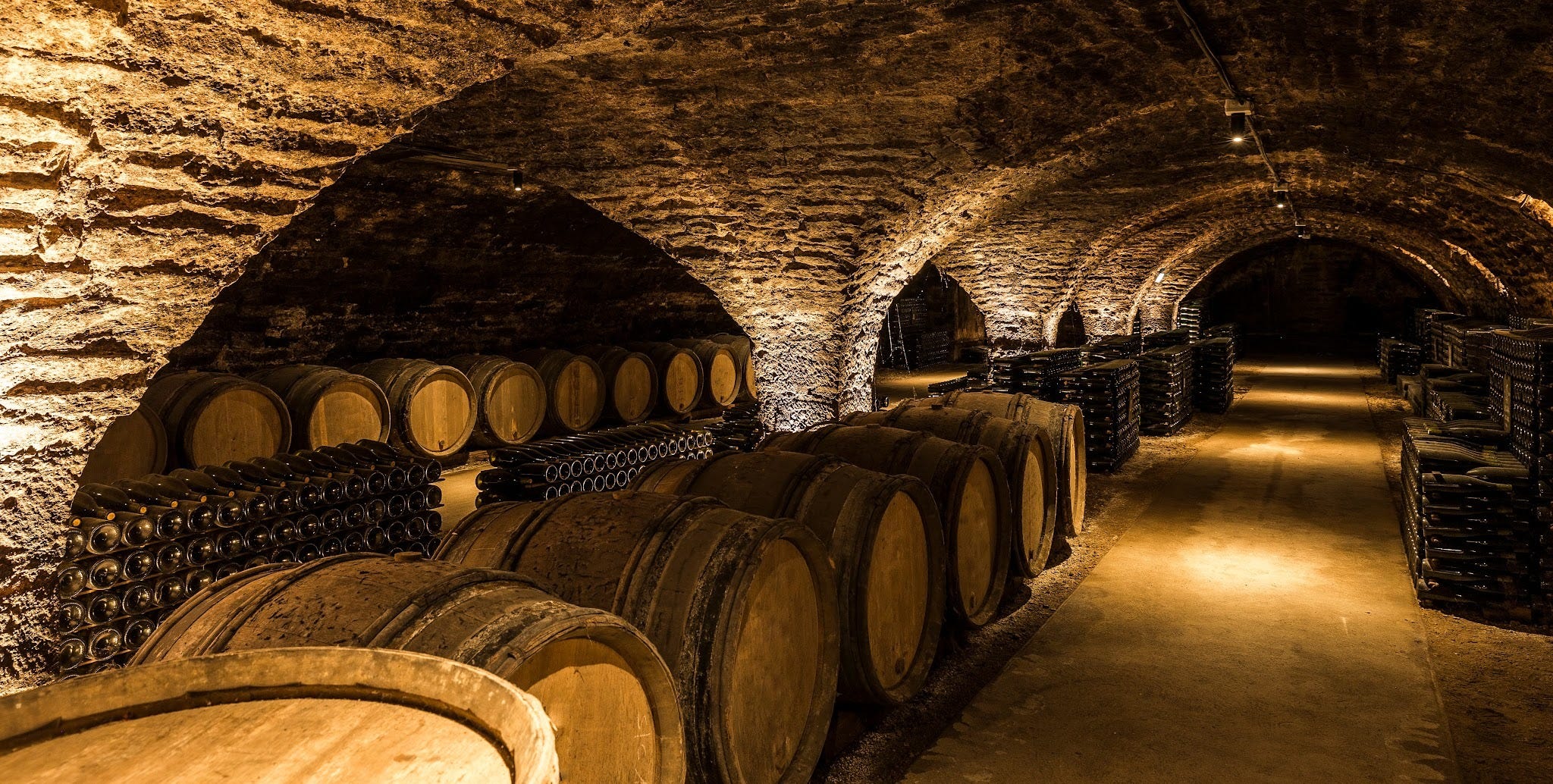
Old cellar with bottles and barrels under a wine domaine
Burgundy has a problem, and it is not the one you might expect. The problem is that the wines most people associate with Burgundy — the celebrated names (think Domaine de la Romanée-Conti et al), the Grand Cru vineyards, the auction darlings — represent only a tiny fraction of the superb wines that are actually made there.
Beneath the headline appellations, largely invisible to the mainstream market, is a constellation of small winemakers making wine of genuine quality and character, from just two grape varieties, often in villages whose names have never appeared on a restaurant list in New York or Chicago.
Finding Hidden Gems in Burgundy: Some Wine Names to Watch For
These are the winemakers that specialist merchants have built their businesses around. These wines are not secrets within Burgundy itself — their neighbours know exactly how good they are, and which are good and great wines. But outside the region, they remain largely undiscovered. That is, for now, an advantage for the buyer who finds them first.
What follows is not a comprehensive list. It is a short selection of winemakers and appellations that represent something specific: serious wine, genuine terroir, and a price that has not yet caught up with the quality. This selection exemplifies the marriage of a few passionate winemakers with the appellations they work in, running the length of the Cote D’Or.
Domaine Joliet, Fixin: Grand Cru Quality Wine at a Fraction of the Price
Fixin sits at the northern end of the Côte de Nuits, separated from the celebrated village of Gevrey-Chambertin by little more than a communal boundary. The two appellations share much of the same geology — limestone-rich soils, mid-slope exposure, the same general latitude and climate — but the prices that Fixin commands are a fraction of its famous neighbour. This is not because the wines are lesser. It is largely because the name is lesser known.
Domaine Joliet’s Fixin Premier Cru Clos de la Perrière is the most compelling argument for reassessing this appellation. Wine has been made in this single enclosed vineyard since 1142, when Cistercian monks from the nearby abbey of Citeaux identified the site as exceptional. Six centuries of careful observation were not misplaced. The wine - mostly red wine from the Pinot Noir grape - is pale ruby, elegant rather than rustic, with fresh red fruit and raspberry aroma, a tension that signals real ageing potential, and a finish that extends far longer than the appellation’s modest reputation would suggest.
Bénigne Joliet, the sixth generation of his family to tend these vines, made a deliberate decision to purchase his land at Premier Cru rather than Grand Cru prices — keeping the tax burden manageable and, crucially, keeping the wine affordable for buyers who pay attention. The New York Times then noticed.
A 2022 feature on the domaine described it as ‘a vineyard’s comeback, 200 years in the making.’ Those who had been buying these wines for years were unsurprised and despite the publicity the domaine still remains a hidden gem…
Maison Capitain-Gagnerot, Aloxe-Corton: A Chardonnay Benchmark Hiding in Plain Sight
There is a white wine bottle in many cellars that wine professionals reach for when they want to make a point about how prestige does not have to be overpriced. The Capitain-Gagnerot Corton-Charlemagne Grand Cru is that bottle. It is made from the same celebrated slope as wines that sell for many thousands of dollars. It is produced by a family whose connection to this land goes back to 1802. And it is priced, by the standards of its peers, with unusual restraint.
Roger Capitain, who ran the estate for decades until his death in 1999, was one of those winemakers whose influence on the people around him outlasted every vintage he produced. His sons and now his grandchildren — Pierre-François and Delphine — have maintained the philosophy he established: low yields, old vines propagated from pre-clonal selection massale stock, minimal intervention in the cellar, and a refusal to let prestige inflate the price beyond what the wine is worth.
The range spans Ladoix, Aloxe-Corton, and Vosne-Romanée at village and Premier Cru level, through to the Grand Cru Corton and Corton-Charlemagne at the top. Each level punches above its classification. The Ladoix Premier Cru Bois Roussot, grown on thick limestone rock, delivers a mineral precision that belongs in the same conversation as wines from considerably more celebrated slopes. The Vosne-Romanée ‘Aux Raviolles’ — red like a jewel, with black fruit and spice — is classic Vosne at a price that represents real value. It has been Ecocert certified since the 2021 vintage, and is not easy to find in the United States without a specialist connection.
Domaine Jean Féry, Échevronne: Biodynamic Burgundy in the Côte de Nuits
The first thing that distinguishes Domaine Jean Féry from most biodynamic winemakers is that Jean-Louis Féry does not lead with the biodynamics. He leads with the wine. His estate in the hamlet of Échevronne, tucked between Beaune and Nuits-Saint-Georges in the Hautes-Côtes, operates according to principles of biodynamic farming — horse-drawn cultivation, preparations of natural minerals and herbs, timing guided by the biodynamic calendar — not as a marketing proposition but as a simple expression of how he believes vines should be farmed.
The results are wines of unusual transparency. The Hautes-Côtes de Beaune ‘La Petite Heulee’ white is crystalline and incisive, with pear, oak, the perfect acidity, and a struck-match minerality that places it firmly in the limestone-driven tradition of the Côte de Beaune despite the elevated, cooler position of the vines. The Vougeot Premier Cru ‘Les Cras’ — from a parcel whose position on the slope rivals sections of the famous Clos de Vougeot — is earthy and complex in a way that its Bourgogne village-level neighbours rarely manage.
Jean-Louis has spent decades expanding thoughtfully: a 2010 acquisition of Chassagne-Montrachet Premier Cru Abbaye de Morgeot confirmed a long-established pattern of identifying sites before the market has fully priced them. These great wines remain largely under the radar outside France and the wider wine world. For the buyer who finds them, that is precisely the point.
Domaine Borgeot, Santenay and Remauré: The Brothers at the Southern End of Burgundy
The wines of the southern Côte de Beaune — Santenay, Maranges, Chassagne-Montrachet — have always offered some of the most reliable value in Burgundy. They sit at the geographical end of the great limestone escarpment, their names are less familiar than the celebrated villages to the north, and their prices reflect that obscurity rather than any shortfall in quality.
Pascal and Laurent Borgeot are fourth-generation winemakers in Remauré, a hamlet within the Santenay appellation. They can often be found at the feast of the Saint-Vincent Tournante in Santenay, the village festooned in paper flowers, brothers doing what they have always done: making elegant wines with quiet seriousness in a place the wider market has not yet fully discovered.
Today, Pascal’s daughter Julia has joined the domaine, bringing her own perspective to a range that spans Santenay, Chassagne-Montrachet, and Rully. The wines are precise, elegant, and structured for ageing — particularly the Chassagne-Montrachet white Burgundy, which combine the richness of the Côte de Beaune with a mineral backbone that extends the finish considerably. The Borgeot name is beginning to appear more frequently in American specialist retail. Those who find them now are ahead of that curve.
Domaine Germain, Saint-Romain: Freshness From the Hills of Côte de Beaune
Saint-Romain is the appellation that climate change has quietly transformed. For decades it was considered a secondary site — too high, too cool, insufficiently ripe in difficult vintages. The hierarchy reflected that: no Premier Crus, no Grand Cru wines, just a village appellation whose affordable wines were pleasant but rarely compelling.
The warming of recent vintages has changed the calculation. At elevation, the freshness that once felt like a limitation now reads as a virtue. Saint-Romain’s Chardonnay, grown on distinctive limestone and marl soils, produces whites of genuine minerality and floral precision — a style that the market is increasingly seeking out as an alternative to the richer, more oaky whites further down the slope.
Domaine Germain Père et Fils, whose vines cover more than 33 acres in Saint-Romain, Pommard, and Beaune, is the producer who best demonstrates what the appellation can achieve. The Saint-Romain Blanc, with eight to nine months in barrel and thirty percent new oak, is rich enough to satisfy but precise enough to intrigue. The Saint-Romain Rouge Sous le Château, from vines up to 53 years old, carries full, juicy fruit on the palate with the kind of underlying structure that suggests cellar potential the appellation is not yet famous for.
Reputation vs Reality: Finding Affordable Quality in Burgundy Wine
What connects these winemakers is not a single style or a shared approach to winemaking. It is something more basic: quality that has not been fully priced by the market. Fixin and the shadow of Gevrey. Ladoix and the reflected glory of the Corton hill. Saint-Romain, an elevated commune, cooling in a warming world. Échevronne, biodynamic and largely unknown outside France. Santenay, making serious Burgundy at the end of the road that most buyers stop travelling before they arrive.
In this article we have picked only a few names that we know are gems of Burgundy; but there are many more lesser known but high-performing domaines throughout the Cote D’Or as well as in the Mâconnais, Chablis and Côte Chalonnaise wine regions just waiting to be discovered.
Don’t forget also the incredible value and quality of Burgundy’s sparkling wine - Crémant de Bourgogne - that casts shade on its more well-known cousins from the Champagne region. And Burgundy’s other grape - Aligoté - which is only grown in selected locations like Bouzeron, is another example of a hidden gem not well known at all outside of this region. We will be covering these and more topics in future articles.
The most reliable principle in Burgundy buying is that the price of a bottle reflects its reputation more than its quality — and reputation lags behind reality, sometimes by decades. Finding the gap between the two is the work. These winemakers are where the gap currently exists.
Great read another of burgundy’s hidden gem for me is aligote
Good read, thank you. A few new names to me.