


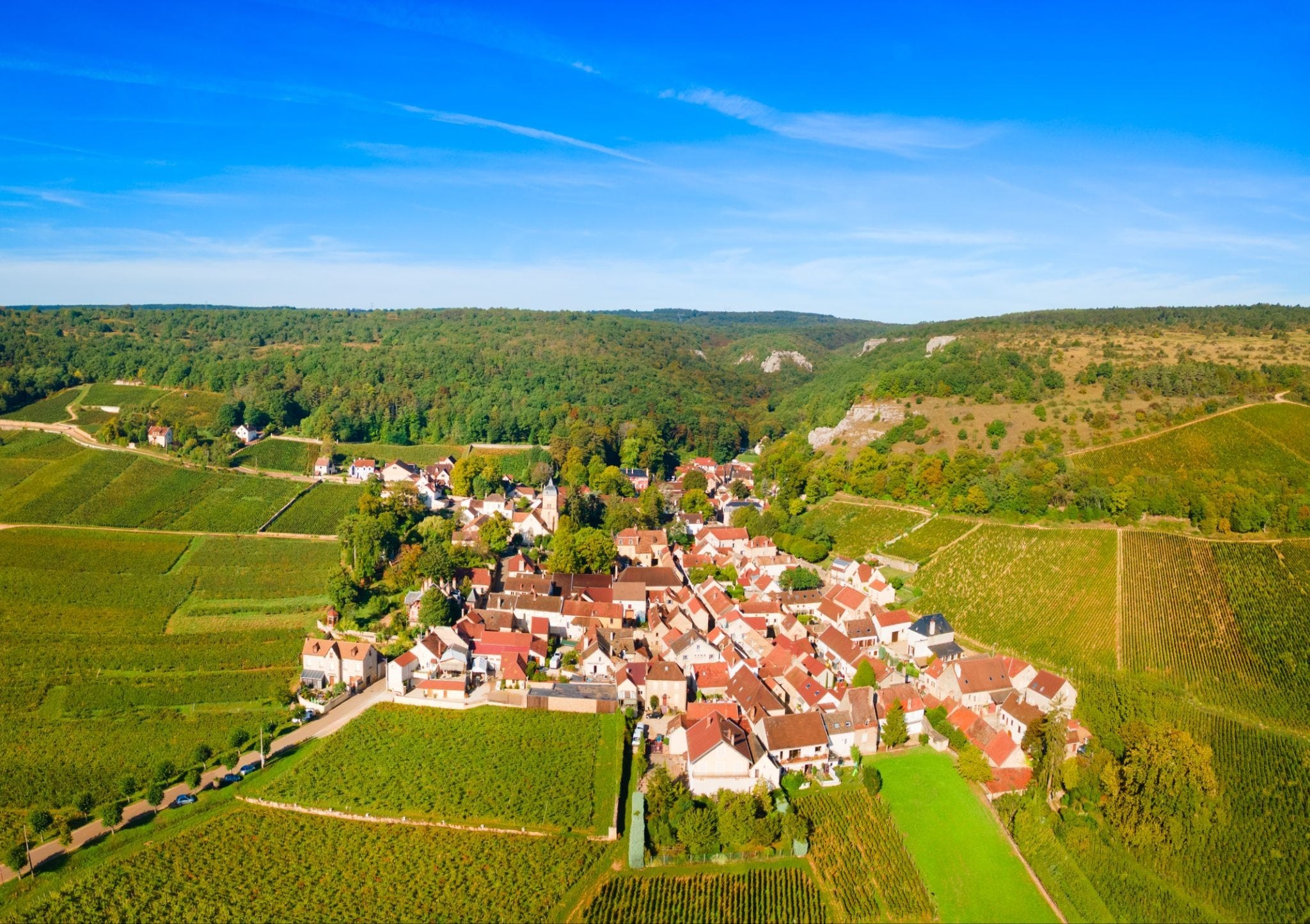
Panoramic aerial view of Chambolle Musigny surrounded by historic Burgundy vineyards
Gevrey-Chambertin and Chambolle-Musigny have been arguing their case to Burgundy drinkers for roughly as long as Burgundy has had drinkers to argue with.
Gevrey stands for structure and power — the Napoleon of villages, as the old line goes, though its reputation for that kind of weight goes back further still, to the era when the Dukes of Burgundy used the region’s finest wines as tools of diplomacy and prestige across medieval Europe. Chambolle stands for perfume and finesse, the wine most often reached for when the word ‘elegant’ needs a real example rather than an adjective. Both are firm favourites with Burgundy collectors the world over. It is one of the oldest rivalries in the Côte de Nuits, and until this year, it had never really been put to a formal test.
Then the Michelin Guide arrived with its grape symbol scoring system, a team of inspectors, and ninety-four rated wine estates spanning the wine region. So: does the data actually settle anything?
Gevrey-Chambertin vs Chambolle-Musigny: What the Michelin Grape Guide Found in Burgundy’s Vineyards
At the very top of the Michelin Grape Selection, the two villages are tied. Among the nine estates awarded the inaugural distinction of three Grapes, Gevrey-Chambertin is represented by Dugat-Py, whose tiny yields and old vines produce some of the most concentrated, age-worthy reds in the appellation. Chambolle-Musigny answers with Domaine Georges Roumier, whose Bonnes-Mares and Musigny sit among the most sought-after bottles in the world, allocation and provenance mattering almost as much as the vintage itself. One estate each, at the very summit. Neither village can claim outright superiority there.
Unlike the white Burgundy of the Côte de Beaune further south, both villages are almost entirely a red Burgundy story — every estate on this list, from Dugat-Py to Roumier, is judged on Pinot Noir alone.
Below that top tier, though, the picture shifts. Michelin’s own writeup singles out Gevrey-Chambertin specifically, noting that the village ‘alone accounts for six estates’ at the two-Grape level — Armand Rousseau, Claude Dugat, Denis Bachelet, Duroé, Joseph Roty and Trapet — a concentration of recognised quality that no other single village in the selection matches. Add Dugat-Py at the top, and Gevrey-Chambertin carries at least seven confirmed estates into the guide’s upper tiers alone, before any of its one Grape or Selected estates are even counted, out of the 94 Burgundy domaines assessed in this first grape selection. Chambolle-Musigny’s presence, by contrast, is narrower: alongside Roumier, names like Comte Georges de Vogüé and Ghislaine Barthod appear further down the Côte de Nuits list, but nothing approaching Gevrey’s depth.
Why Gevrey-Chambertin Has the Numbers: A Burgundy Wine Grape Breakdown
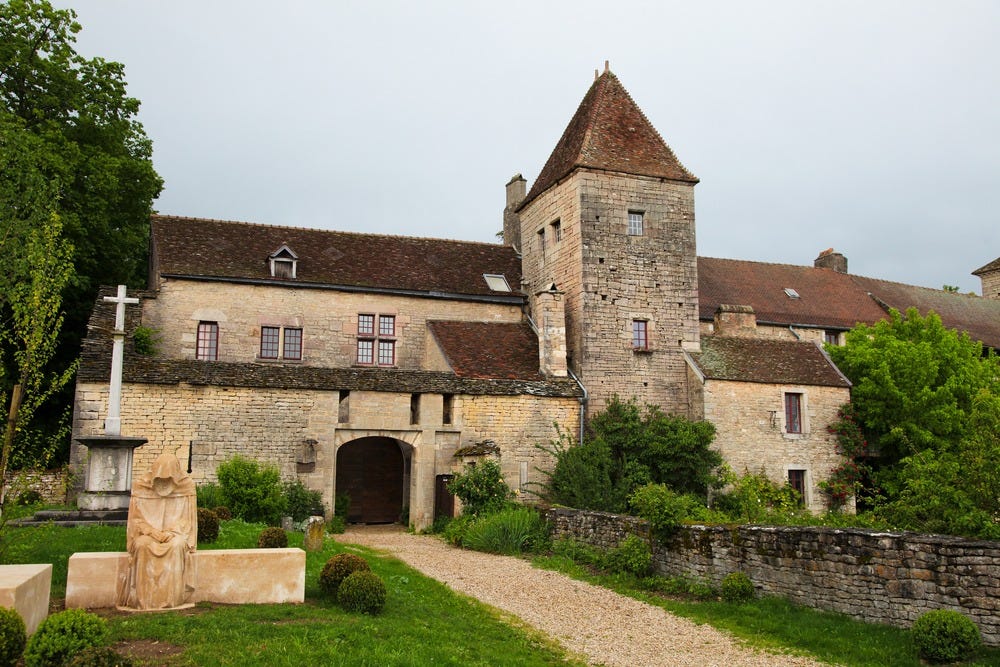
The Chateau de Gevrey-Chambertin, 12 km from Dijon and 30 km from Beaune.
This is not really a surprise, once you consider the underlying geography. Gevrey-Chambertin is the largest village on the Côte de Nuits by vineyard area, with more Premier Cru and Grand Cru land than any of its neighbours and a correspondingly large number of family domaines working small parcels within it. More vineyard land and more independent winemakers naturally means more opportunities for a five-criteria assessment to find estates worth recognising. Breadth, in other words, is partly a function of scale.
Chambolle-Musigny is a considerably smaller appellation, both in total hectares and in the number of domaines working it. Fewer estates were always going to mean fewer names on any list, however good the wines. Michelin’s tally is, in that sense, as much a reflection of Gevrey’s size as it is a verdict on Gevrey’s quality — though the two are not entirely unrelated, since a village with this much serious vineyard land was always likely to have developed a correspondingly serious roster of winemakers over the generations.
Why Chambolle-Musigny Still Feels Like the Winner: The Case for Three Michelin Grapes
Numbers are not the only currency that matters in Burgundy, and anyone who has tried to secure an allocation of Roumier’s Bonnes-Mares knows this instinctively.
Chambolle-Musigny’s smaller output has, if anything, sharpened its reputation rather than diluted it: scarcity has always done useful work for prestige in this part of the world. A single three-Grape estate whose wines routinely sell for more than most Gevrey Grand Crus is not really a village that needs six more names on the list to make its case.
There is also the matter of style. Gevrey’s structure and Chambolle’s perfume appeal to genuinely different instincts in a drinker, and Michelin’s criteria — agronomy, technical mastery, identity, balance, consistency — were never designed to adjudicate between two valid but opposite ideas of what makes Pinot Noir great. A rating system built to recognise quality within a style is not well placed to declare one style categorically superior to another, and it would be a strange outcome if it tried.
The Real Answer: What This Means for Burgundy Wine Lovers
None of this actually settles Gevrey versus Chambolle. It just gives the old argument better numbers to argue with. Gevrey wins on depth — more recognised estates, more range across more price points, the natural result of being bigger and having had centuries longer to build up talent. Chambolle wins on height, at least through Roumier: a smaller village whose limited output has only sharpened its reputation, and whose best bottles remain some of the most fought-over in Burgundy no matter how many other names from the village made Michelin’s list.
All of which brings us back to something worth remembering for the entire Burgundy region whenever a rating system runs into the famous complexity of the area: a village doesn’t make the wine. Rather, a domaine does, on a certain patch of ground, in a specific year. Also, a score of two Michelin Grapes or three isn’t the whole story; Gevrey-Chambertin and Chambolle-Musigny have both just demonstrated, in their own way, why neither can be flattened into a single score.
For a fun tasting comparison head over to burgundywine.com. They recommend a head to head tasting of these two wines from these two great appellations. Both from the same winemaker :
Domaine Marchand Frères Chambolle Musigny Vieilles Vignes-2021
Domaine Marchand Frères Gevrey Chambertin Vieilles Vignes-2021