


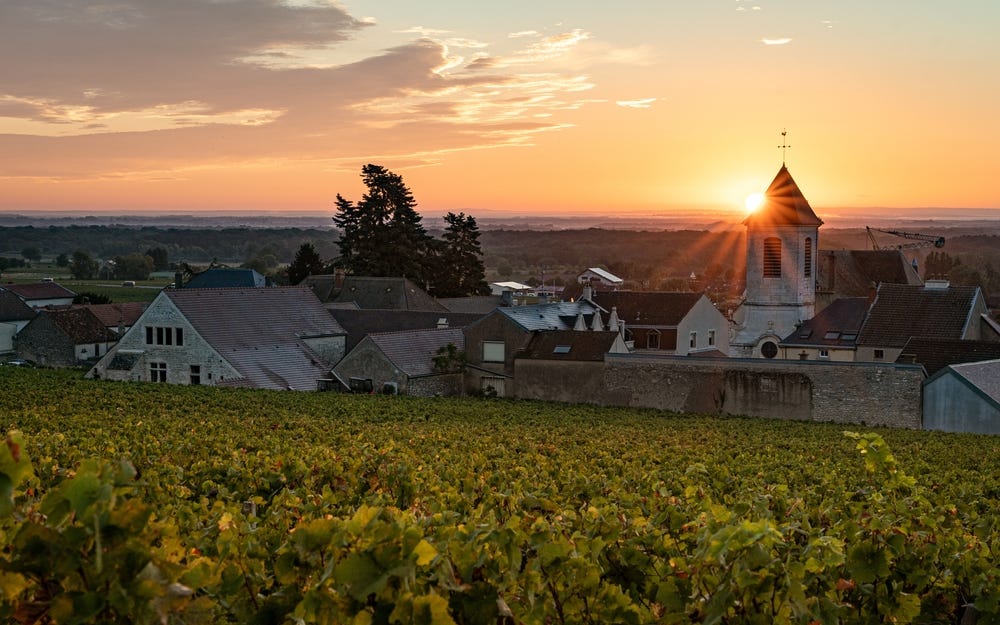
Sunrise in Morey-Saint-Denis and Chambolle-Musigny vineyards, Burgundy, France
Most introductions to the Burgundy wine region begin with a pyramid. You’ve probably seen it; regional and village at the base, Premier Cru above it, Grand Cru at the top. It’s a useful diagram, and it isn’t wrong. But it teaches hierarchy more than it teaches wine. What it won’t tell you is why the levels feel different in the glass, what actually changes as you move up the slope, and why two bottles at the same classification level can taste so different from each other.
This article - a guide to Burgundy focussed on one of its most famous regions - takes a different approach. Rather than explaining the system from the outside, it traces the land and geology of the Côte d’Or region of Burgundy from the ground up — from a regional Bourgogne grown on the limestone heartland, through three contrasting villages, to Premier and then a Grand Cru that distils everything below it into something more concentrated and more complete. The aim isn’t to memorise the hierarchy; it is to understand what the hierarchy is actually measuring.
The Côte d’Or: The World Class Wine Region With Enormous Range
The Côte d’Or is a thin escarpment of limestone running roughly 50 kilometres from Dijon in the north to Santenay in the south. It is divided into two parts: the Côte de Nuits in the north, which produces red wine from the Pinot Noir grape almost exclusively, and the Côte de Beaune to the south, which produces both the region’s finest red and its greatest white Burgundy from the Chardonnay grape.
What gives this Burgundy region its character is geology - and therefore its terroir. The hillside is composed of layered Jurassic limestone, laid down over millions of years in varying densities and depths. The mid-slope — where the best vineyards consistently sit — benefits from good drainage, adequate sun exposure, and a limestone subsoil close enough to the surface that vine roots must work to find water and nutrients. That effort is what gives the wines their precision and their longevity. The lower slopes are richer in clay and tend to produce broader, less structured wines. The upper slopes are thinner in soil and more exposed; they can produce wines of aromatic lift but less body.
The Appellation - the Key to Understanding Burgundy
The classification system exists, in theory, to reflect this geography. The same two grapes, Pinot Noir and Chardonnay, are used throughout the region but with very different characters (depending on location and winemaker). The best-sited mid-slope parcels were classified first as Premier Cru and Grand Cru. The flatter, lower parcels became village appellations. Regional Bourgogne could be sourced from anywhere within the defined region. In practice, the system was codified over decades and has its anomalies — some Premier Cru vineyards outperform their Grand Cru neighbours, and some village wines from exceptional producers rival classified wines at twice the price. But the general logic holds, and understanding it makes every bottle easier to read.
The Starting Point: Bourgogne Côte d’Or
The Bourgogne Côte d’Or appellation is a relatively recent creation, formally recognised in 2017, representing one of the most useful developments in Burgundy buying for American consumers. Unlike generic Bourgogne, which can be from across the wider region, fruit for these wines must come specifically from the limestone heartland of this part of Burgundy. The best examples have a very mineral structure, lifted red fruit, and a clarity that links them unmistakably to the villages above.
Think of Bourgogne- level wine as a calibration wine. It shows you how the Côte de Nuits tastes before site specificity and prestige amplify things. Take as an example a domaine like Marchand Frères, whose vineyards span multiple appellations across the Côte de Nuits; their regional wine is made with the same care as the village and Premier Cru bottles — manual harvesting, sorting in the vineyard, fermentation that responds to the vintage. The result is wine that earns its origin rather than simply stating it.
The Village Level: Three Different Arguments
Move up from regional Bourgogne into the named villages of the Côte de Nuits and the differences become immediately apparent — not just in quality, but in character. Three villages illustrate this range more clearly than any diagram.
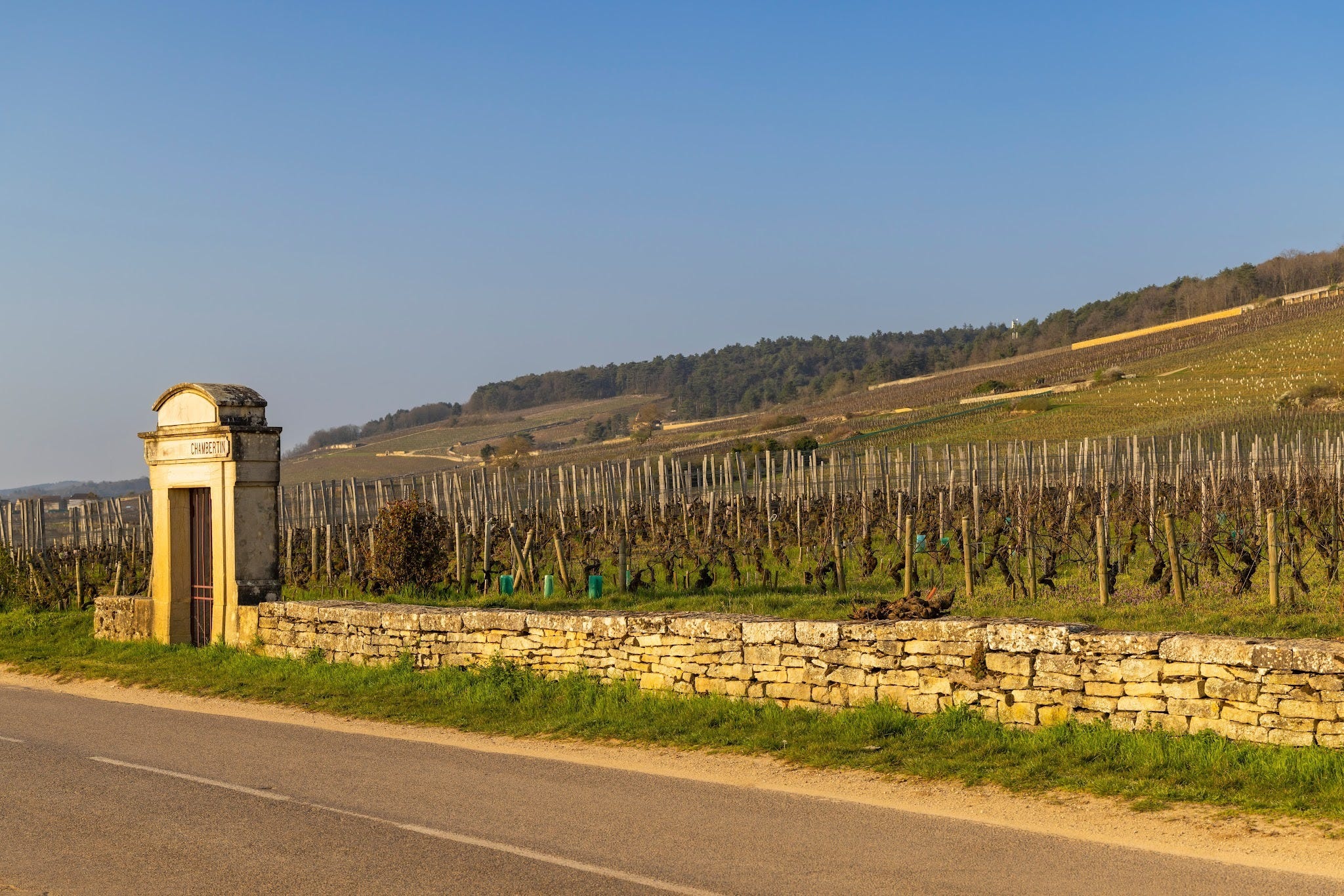
Chambertin Clos de Beze Grand Cru vineyard in Gevrey Chambertin, Burgundy, France
Gevrey-Chambertin is the largest and most structurally assertive village on the Côte de Nuits. The wines tend toward darker fruit — blackcurrant, plum, a hint of iron and earth — with tannins that feel architectural rather than decorative. This is Pinot Noir that expects time. A village Gevrey from a careful producer needs three to five years to begin showing its full range, and will continue to develop for a decade or more. The terroir here is deeper and richer than further south, which gives the wines their density and their sometimes austere character in youth.
Chambolle-Musigny sits just a few kilometres to the south and produces wine of an entirely different temperament. Where Gevrey speaks in structure, Chambolle speaks in perfume — violet, rose, red berry fruit, and a finish that seems to hover rather than land. The soils are thinner here, with more active limestone near the surface, and the result is wines of unusual delicacy and finesse. Even in warmer vintages, Chambolle retains a transparency that is one of the most distinctive signatures in all of Burgundy.
Morey-Saint-Denis occupies the strip between these two giants and often acts as the translator between them: more structure than Chambolle, more aromatic lift than Gevrey, and an innate balance that makes it one of the most complete villages to drink at mid-range prices. It is frequently overlooked by buyers chasing the better-known names on either side, which means it often represents some of the best value on the Côte de Nuits.
Tasted side by side, these three villages demonstrate that the village level of the Burgundy hierarchy is not a single flavour profile. It is a range of arguments, each made convincingly by a different piece of ground.
The Premier Cru Level: Where Terroir Begins to Speak
Premier Cru is where the Burgundy hierarchy becomes genuinely interesting, because it is where specific named vineyards — rather than villages — begin to define the wine. There are hundreds of Premier Cru designations across the Côte d’Or, each one tied to a particular parcel of land whose character is distinct enough to warrant its own name on the label. The format is always the same: village name first, vineyard name second. Chambolle-Musigny Les Amoureuses. Gevrey-Chambertin Lavaux Saint-Jacques. Vosne-Romanée Les Suchots.
What changes at Premier Cru level is not simply quality — it is specificity. A village Chambolle-Musigny expresses the general character of that commune: its perfume, its fine tannins, its limestone-driven precision. A Premier Cru Chambolle from Les Amoureuses — a parcel that sits immediately below Grand Cru Musigny on the mid-slope — does something more particular. The aromatic lift is greater, the mid-palate more layered, the finish longer and more defined. You are no longer tasting a village. You are tasting a specific piece of terroir within that village, one whose exposure, drainage and vine age have been deemed, over centuries of observation, to produce something consistently finer than its neighbours.
Premier Cru wines also represent the level at which ageing potential increases most noticeably. A well-made village Gevrey may need three to five years to open fully. A Gevrey Premier Cru from a good vintage will often be at its best between eight and fifteen years from harvest. This is not a reason to avoid them — many of these wines drink beautifully young, particularly from Chambolle and Morey — but it is a reason to approach them with patience in mind. At this level of the hierarchy, time is not an inconvenience. It is part of how the wine was designed to work.
The Grand Cru Level: What Changes and What Doesn’t
Grand Cru vineyards represent the top two percent of Burgundy production. There are 33 Grand Cru appellations in total, concentrated almost entirely on the Côte d’Or. They stand alone on the label — no village name is needed, because the vineyard name is itself the address.
Chambertin. Musigny. Montrachet. These are not villages. They are specific parcels of land whose reputations were established centuries before the modern classification system confirmed them.
Charmes-Chambertin is one of the largest and most accessible Grand Cru vineyards in Gevrey, and it illustrates well what Grand Crus actually are in practical terms. Compared to a village- Gevrey, Charmes offers greater aromatic depth, a more layered mid-palate, and a finish that extends considerably longer. The tannins are present but integrated; the fruit is richer and more complex; the wine has a sense of scale that village bottles, however good, rarely achieve. It is Gevrey written in capital letters — but with warmth and generosity that makes it approachable younger than some of its neighbours.
What wine made from Charmes-Chambertin amply demonstrates is that Grand Cru is not simply a more expensive village wine. It is wine from a site where the geology, drainage, sun exposure and vine age combine in a way that amplifies the regional character without distorting it. The limestone is closer to the surface, the drainage is more precise. The yields, in the hands of a serious producer, are lower. Every variable points in the same direction.
Domaine Marchand Frères, whose production at Grand Cru level is measured in dozens of cases rather than thousands, makes Charmes-Chambertin as a conclusion rather than a statement. It is reached only after everything below it — the Bourgogne, the village wines, the Premier Crus — has been done correctly. That approach is visible in the glass: the wine has nothing to prove, because the work has already been done in the vineyard.
How to Use This Burgundy Wine Knowledge When Buying
Understanding the shape of the Côte d’Or changes how you approach a wine list or a shop shelf when buying Burgundy wine. The hierarchy is not a ranking of prestige so much as a guide to character, concentration, and ageing potential. A village Chambolle from a careful producer will almost always outperform a Grand Cru from a careless one — and this is true at every level of the pyramid.
Perhaps the most practical use of this knowledge is the producer question; before asking what level the wine is, true Burgundy wine lovers ask “who made it?” A Bourgogne Côte d’Or from Marchand Frères or a comparable serious domaine is a more reliable choice than a village wine from a name you do not recognise. The hierarchy matters, but it shouldn’t replace the attention you pay to the person who made the wine.
The second thing to keep in mind is patience. Village wines from the Côte de Nuits — Gevrey in particular — are often bought and opened too early. Premier and Grand Cru wines even more so. If you are buying to drink immediately, Chambolle and Morey are more forgiving than Gevrey. If you have a cellar and time, Gevrey and Charmes-Chambertin will reward you more generously than almost anything else the region produces.
Lovely accessible article !