


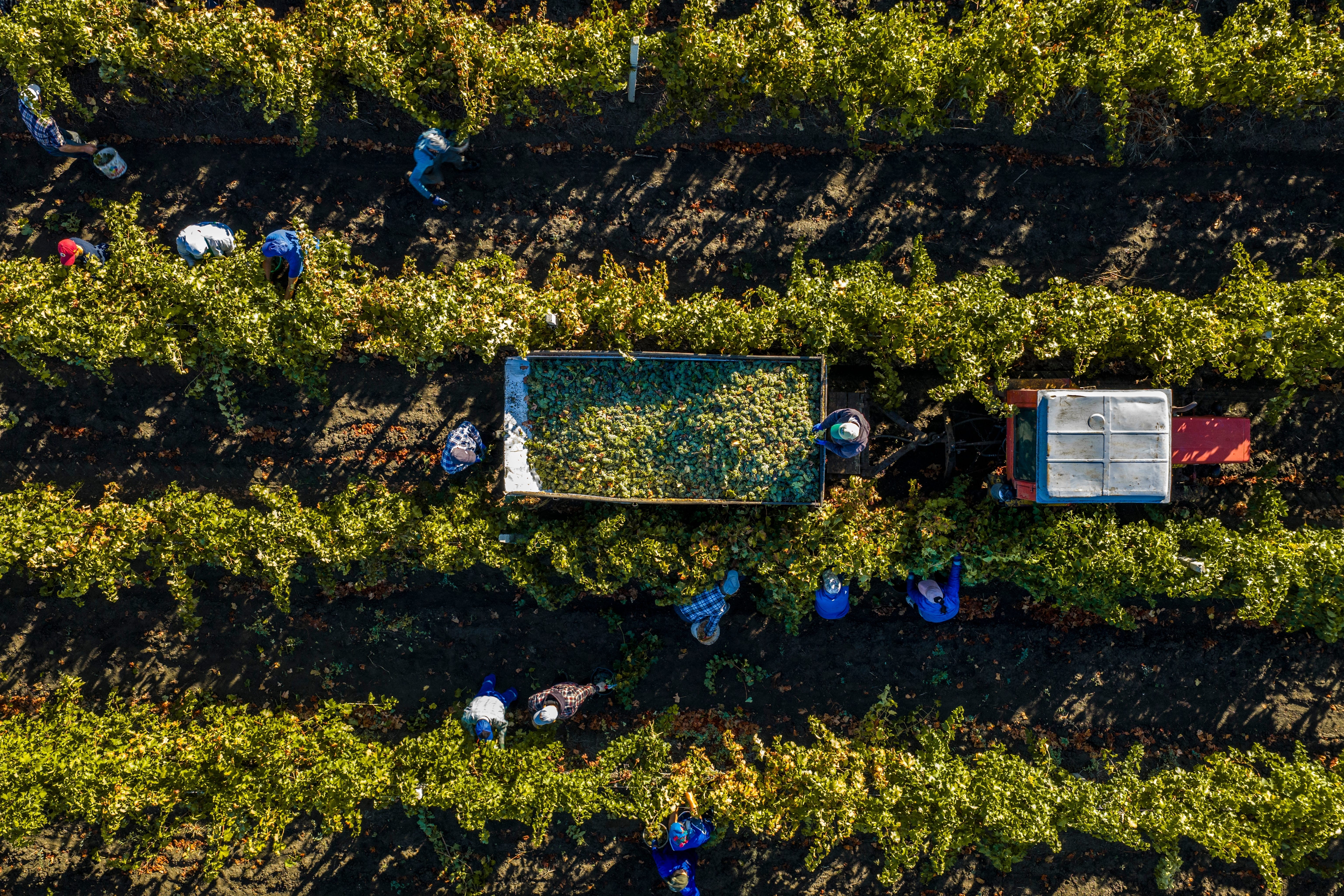
There is one subject dominating conversation across Burgundy’s wine regions this week: the harvest. That is hardly unusual for late August. What is unusual is how much of it has already happened — and how far ahead of schedule growers across the region now find themselves, after a growing season shaped by repeated heatwaves that has moved at a pace nobody quite anticipated, a pattern stretching from Bordeaux to Burgundy this summer.
On 13 August, pickers were out in the Grand Cru vineyard of Montrachet, and Domaine Leflaive announced that picking began there. It made harvest 2026 the earliest harvest date recorded for a still-wine harvest in Burgundy’s history — other estates had already been bringing in grapes earlier for sparkling wines, but this was the first for the region’s still wines — breaking a record that had stood since 15 August 1556.
That was confirmed by the climate historian Thomas Labbé of the University of Burgundy, whose research has reconstructed grape harvest dates in Beaune back nearly seven centuries, to 1354. Five hundred years is an exceptionally long time for a record to survive. This year, it did not.
The more interesting question, though, is not really ‘how early’. It is ‘what is actually arriving in the cellars’ — and what that will mean for the wine itself.
This Earliest Harvest Doesn’t Necessarily Mean a Poor One
The encouraging news is that the grapes being picked are, by most reports, in very good condition. Sugars are high, acidity has held up better than the heat of the summer might have suggested, and the fruit is described as healthy, with promising aromatics and good concentration. The basic ingredients, in other words, are there.
That reframes the challenge facing growers this year rather than removing it. In a cooler vintage, the anxiety usually centres on whether the grapes will reach sufficient ripeness before autumn weather closes in. In this 2026 season, the pressure runs the other way: ripeness has arrived quickly, and the decision growers now face is when to stop waiting. Pick too early, and there is a risk of leaving potential on the vine. Pick too late, and the fruit can lose the freshness and acid balance that gave it its promise in the first place. Finding the right point between those two risks is a matter of judgement rather than formula — and it is exactly where the experience of Burgundy’s vignerons matters most.
The Vineyard Matters More Than the Calendar
One of the clearer lessons of Burgundy’s recent run of warm vintages is that a single harvest date no longer tells the whole story. When it comes to grape harvests in Burgundy, exposure, altitude, soil, vine age, aspect and farming practice can all shift the picture, and two vineyards only a short distance apart can now reach optimal maturity on noticeably different days — a pattern showing up as clearly in Pinot Noir sites across the Côte de Nuits as it is in the Chardonnay of Montrachet. Harvest times that once fell within a narrow window across the region are now spreading further apart each year.
This helps to explain the growing interest in higher-elevation sites. As temperatures climb, vineyards once considered too marginal for reliable ripening can find themselves with an unexpected advantage: they hold onto their freshness for longer while still reaching full ripeness in the end.
Harvest 2026 is, in that sense, another reminder that Burgundy has never been just one growing environment. It’s really a patchwork of thousands of individual parcels, each answering the same summer challenges in their own particular ways.
A Vintage That Will Reward Judgement
The heat of 2026 has inevitably invited comparisons to other warm years. But comparisons between vintages can only carry an argument so far. What matters more is what individual growers do with the conditions they have actually been given, and how well that judgement holds up against the demands of harvest this year specifically.
Careful canopy management, close attention to soil health, and increasingly precise decisions about exactly when to pick are all likely to play a role in how this vintage turns out. The same principle carries through into the cellar: the best intervention tends to be the kind that serves the fruit rather than tries to disguise the character of the year.
Early reports suggest 2026 may be a vintage where that kind of judgement counts for more than usual — and where a grower who picks at precisely the right moment stands to produce something with the combination Burgundy drinkers are always chasing: ripe fruit, energy, freshness and balance, all at once.
The Grape Harvest Across Burgundy
The spread of picking dates this year is already illustrating these differences in real time. Some of the region’s warmest, lower-lying vineyards moved into harvest rapidly, while growers at higher elevations have been able to hold on longer.
As we were writing this piece, we went looking for an example of a domaine dealing with the early harvest on our actual publication date — and found one close to home. Domaine de Cromey begins picking today, 25 August, in Le Clos, their historic vineyard at higher elevation. That is early by any historical standard, but noticeably later than several vineyards already harvested elsewhere in the region this month.
It is a useful, live illustration of how much terroir still matters in a year like this one: even within a region living through the same broad weather pattern, elevation and site can buy a grower valuable extra days. In 2026, a handful of those days may end up mattering a great deal.
Burgundy Wine and Climate Change: Never Standing Still
The larger point here is undeniable: harvests in Burgundy are becoming earlier, climate change is reshaping the conditions its winemakers have worked with for generations and the pace of that shift is becoming harder to miss with every passing year.
The scale of the acceleration is genuinely striking. Between 1354 and 1719, exceptionally hot growing seasons like this one occurred roughly every 17 years, according to Labbé’s data. Over the past twenty-five years, that frequency has risen to once every two and a half years — eight such extreme early harvests have occurred within the last 30 years alone — and four of the ten hottest years in the entire 664-year Beaune record have now fallen within the twenty-first century alone. Water shortages caused by heat and drought, once a rare complication, are becoming a routine part of the conversation each summer. What was once treated as an outlier is, in the language of Labbé’s own research, simply a feature of the present climate.
It would be a mistake, though, to read an early harvest as a signal that great Burgundy is somehow coming to an end. If anything, the opposite looks closer to the truth. Growers are adapting: vineyard sites are being reassessed, higher elevations are drawing fresh attention, farming practices are evolving in wine production, and winemakers are steadily learning how to respond to conditions that would once have counted as exceptional.
Harvest 2026 is simply the latest test of that adaptability — not a story about heat and accelerated ripening alone, but one about judgement, and about the sheer diversity of Burgundy’s vineyards holding up under real pressure.
The Wine of 2026: Plenty of Reasons for Optimism Despite the Drought
For now, the signs are genuinely encouraging. The grapes are healthy, ripeness has arrived, and acidity has in many cases held up better than expected. Across Burgundy, growers are making the calls that will ultimately shape the character of this vintage — and fermentation and élevage still have a great deal left to reveal before anyone can properly assess what 2026 has produced.
The harvest may be historically early, and we will have to get used to more exceptionally hot seasons. But that is only one part of the story. Burgundy has changed before, and it will keep changing — the vines have proven resilient, the growers inventive, and for now, at least, the fruit is giving them plenty to work with.
Wild that the vineyards people used to write off as too high are now the ones saving the vintage.
It’s remarkable that a record going back to 1556 can fall and yet “earliest harvest ever” still tells us surprisingly little about whether the wine will be good. The shift from worrying about achieving ripeness to deciding when you’ve had enough of it really changes where the grower’s judgment matters.