


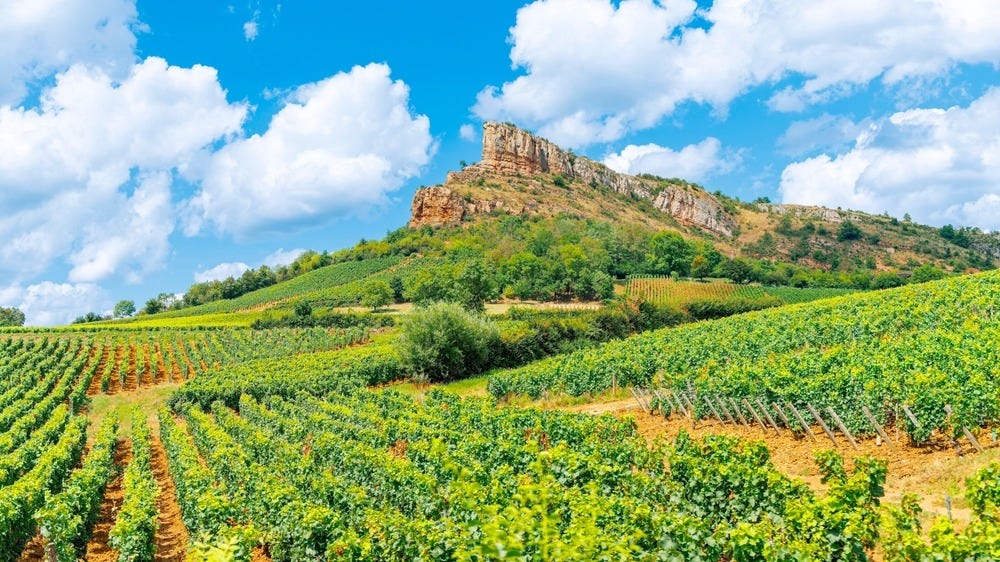
Solutré Rock with vineyards, Burgundy, France
Burgundy is not one place. This is the first thing to understand, and it is the thing that confuses new buyers most reliably. When someone says they love Burgundy, wine they might mean the steely mineral whites of a cool northern appellation, or the rich, generous reds of a sun-warmed limestone hillside several hundred kilometres further south. Both are Burgundy.
Both are made under the same AOC classification framework, by the same traditions, from the same two grape varieties. And yet they taste as though they come from different countries.
The Six Burgundy Wine Regions
The explanation is geography.
Geographically, Burgundy stretches nearly 300 kilometres from north to south, taking in six distinct wine-producing regions, each with its own climate, its own geology, and its own relationship with Pinot Noir and Chardonnay. Understanding those six regions does not require a degree in geology. It requires only a willingness to think of Burgundy as a journey rather than a single destination — and to notice what changes as you travel from north to south. What follows is our guide to understanding Burgundy geography, and where to find some of the best vineyards in Burgundy - indeed, in the world.
1. Chablis and the Grand Auxerrois: The Cool, Stony North
Begin at the northernmost part of Burgundy, where the town of Chablis sits in the valley of the river Serein, well north of Dijon and far removed from the gentle warmth that characterises the Côte d’Or. This is marginal wine country by the standards of the rest of Burgundy — cool, prone to frost, and shaped by geology that has no parallel further south.
The defining characteristic of Chablis is its soil: Kimmeridgian limestone, laid down approximately 150 million years ago when this part of central France was an inland sea. The evidence of that origin is visible — tiny fossilised oyster shells appear throughout the earth — and it is tangible in the wine. Chablis has a mineral quality that is almost impossible to replicate elsewhere: a steeliness, a flinty, saline edge that makes it one of the most immediately distinctive white wines in the world.
The Grand Auxerrois, which encompasses the broader Yonne département around Chablis, includes the red wine appellations of Irancy and Bourgogne Côte Saint-Jacques, as well as smaller whites such as Saint-Bris. These wines are rarely seen outside specialist circles, but Irancy in particular — a red Pinot Noir allowed to include a small proportion of the old César grape — produces something genuinely distinctive: floral, peppery, structured, and still priced well below its southern equivalents.
2. The Côte de Nuits: The Heartland Wine Region of Red Burgundy
Drive south from Dijon and within a few kilometres the landscape announces itself. The limestone escarpment of the Côte d’Or rises to the west, and the vineyards begin. The northern section of this escarpment — running for roughly 20 kilometres from Marsannay to Corgoloin — is the Côte de Nuits, and it is the most concentrated source of great red Burgundy in the whole wine world. You may have heard of it in relation to one of its most famous landmarks - Cîteaux Abbey, the original home of the Cistercian monks and now one of France’s greatest treasures. The monks themselves did much to develop the craft of wine production, a heritage that was continued centuries later by the Dukes of Burgundy in the middle ages.
The Côte de Nuits produces almost exclusively red wine from Pinot Noir, and the villages along its length read like a list of the most celebrated names in wine: Gevrey-Chambertin, Morey-Saint-Denis, Chambolle-Musigny, Vougeot, Vosne-Romanée, Nuits-Saint-Georges and of course the world-famous Romanée-Conti. These village wines all have their own character — Gevrey is structured and powerful wine, Chambolle is perfumed and delicate, Vosne is silky and complex — and the best vineyards on the mid-slope carry Grand Cru status that has been recognised for centuries.
What makes the Côte de Nuits so singular is the combination of Jurassic bedrock, east-facing slopes that catch the morning sun while avoiding afternoon heat, and a mesoclimate that allows Pinot Noir to ripen fully without losing the acidity that gives the wines their structure, elegance and longevity. This is vin rouge designed for time: the greatest bottles from Vosne-Romanée and Chambolle-Musigny are at their best only after a decade or more in the cellar.
3. The Côte de Beaune: Where the Whites and their Terroir Begin to Speak
The Côte de Beaune picks up where the Côte de Nuits ends, running south from the hill of Corton through Beaune and on to Santenay. It is a more diverse region than its northern neighbour: the reds of Pommard and Volnay are among the finest in Burgundy, and the Grand Cru Corton produces both exceptional red and the magnificent Corton-Charlemagne white. But it is white Burgundy wine that has made the Côte de Beaune’s reputation most securely.
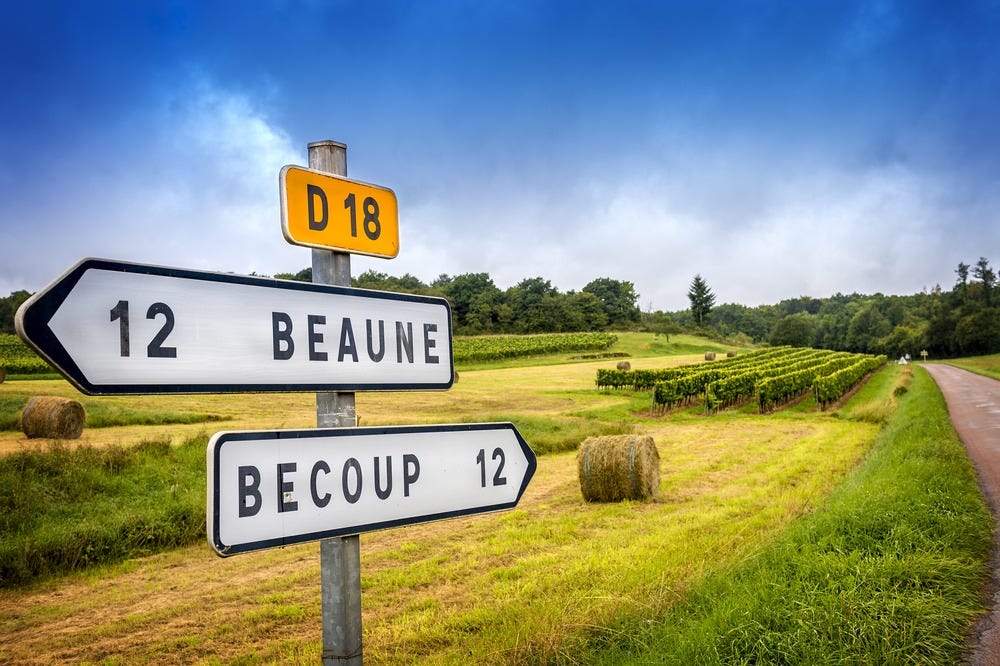
Burgundy road sign to the historic wine capital of Beaune
The villages of Meursault, Puligny-Montrachet, and Chassagne-Montrachet between them account for the greatest concentration of world-class Chardonnay on the planet. Seven of Burgundy’s eight white Grand Cru vineyards sit here — Le Montrachet, Chevalier-Montrachet, Bâtard-Montrachet among them. The soils here contain more active limestone and less clay than the Côte de Nuits, which gives the white wines their particular texture: rich and generous, but with a mineral backbone that distinguishes them from New World Chardonnays of comparable ripeness. This region is also the home of some of the finest sparkling Burgundy wine - Crémant de Bourgogne - you can get. Saint Aubin, for example, is where winemaker Louis Picamelot makes some of his finest Crémant.
The southern end of the Côte de Beaune — Chassagne-Montrachet, Santenay, and Maranges — offers some of the best-value wines in the entire region. The soils are slightly different, the names are less famous, and the prices reflect that gap between reputation and quality that patient Burgundy lovers have always found rewarding. As one experienced guide to the region puts it, quality in Burgundy is perpetually climbing the hill — and nowhere is that more evident than at the southern end of the Côte de Beaune.
4. The Côte Chalonnaise: The Five Winemaking Villages Worth Knowing
South of Beaune, the continuous escarpment of the Côte d’Or gives way to a more fragmented landscape. The hillside drops; the vineyards become more dispersed; the continuity of the Côte is lost. This is the Côte Chalonnaise, named for the nearby city of Chalon-sur-Saône, and it is one of Burgundy’s most consistently underestimated regions.
Five communes define the Côte Chalonnaise, running north to south: Bouzeron, Rully, Mercurey, Givry, and Montagny. Bouzeron is the home of Aligoté — Burgundy’s second white grape, producing wines of fresh, citrus-driven character at prices well below the Côte d’Or. Rully produces both red and white wine with increasing sophistication. Mercurey is the largest and most commercially prominent, with substantial Premier Cru holdings producing reds of real depth. Givry makes charming, accessible reds that drink beautifully young. Montagny, almost entirely white, produces Premier Cru Chardonnay of mineral precision that rivals village-level Puligny at considerably lower prices.
The vineyards here sit at slightly higher elevation than the Côte d’Or, which means a later harvest and a climate where vintage variation matters more. But the soils remain broadly similar — limestone and clay in varying proportions — and the best winemakers consistently turn that into something worth seeking out. Domaine Borgeot’s Mercurey and Montagny bottlings, for example, demonstrate what the Côte Chalonnaise can achieve when a skilled winemaker commits to site and vine quality without distraction.
5. The Mâconnais: Chardonnay at Its Most Generous
Continue south another 35 miles and the landscape changes again. The hills give way to a softer, warmer terrain, the sky seems wider, and the wines — almost entirely Chardonnay — become noticeably richer and more immediately approachable. This is the Mâconnais, the southernmost white wine region of Burgundy proper, and it produces some of the most persuasive arguments in the region for wine lovers buying outside the famous appellations.
The signature appellation is Pouilly-Fuissé, whose two great rock formations — the cliffs of Solutré and Vergisson — provide one of the most dramatic backdrops in Burgundy. The wines from vines planted at the foot of these rocks combine tropical richness with a mineral finesse that sets them apart from generic Mâcon. In 2020, Pouilly-Fuissé received Premier Cru status for 22 of its best climats — a recognition that confirmed what attentive buyers had known for decades: this is serious Chardonnay, deserving of the same attention as the Côte de Beaune’s most celebrated whites.
Saint-Véran and Macon-Villages offer the most accessible entry points into the Mâconnais: lighter, fruitier, and less demanding than Pouilly-Fuissé, but made from the same limestone-influenced soils and sharing the same fundamental character. For the buyer who finds the Côte de Beaune expensive and Chablis austere, the Mâconnais offers a middle path — Burgundian in origin and philosophy, but warmer and more immediately welcoming in style.
6. Beaujolais: The Grape That Changes Everything
The sixth region of Burgundy is the one that most surprises newcomers — because it does not use Pinot Noir. Beaujolais, which extends south from Mâcon toward Lyon, is Gamay country: a different grape, a different soil, and a different style of wine that sits in a genuinely ambiguous position in the Burgundy framework. Administratively it falls within the broader Burgundy wine region; stylistically it belongs to a world of its own.
Ninety-eight percent of Beaujolais wine is red, made from Gamay grown on granite-rich soils in the north of the region and clay-sandstone soils further south. The granite terroir of the north produces the ten Beaujolais Crus — Moulin-à-Vent, Morgon, Fleurie, Brouilly, and six others — whose wines have a complexity and ageing potential that their unpretentious reputation rarely suggests. Moulin-à-Vent in particular, from old vines on manganese-rich granite, can develop over a decade into something that only a specialist could distinguish from a modest Côte de Nuits red.
For buyers who approach Beaujolais primarily through Beaujolais Nouveau — the annually hyped early release that arrives in November — the ten crus are a genuine revelation. They represent Burgundy at its most unpretentious: grown on ancient volcanic and granite soils, made by small wine domaines who rarely advertise, and priced at a level that rewards curiosity rather than presupposing a large budget.
How to Use the Map When You Buy Burgundy Wine
The practical value of understanding Burgundy’s six regions is that it transforms every purchase from a gamble into an informed choice. Before asking which wine appellation or which winemaker, it helps to know which region you are in, what the underlying geology is doing, and what the climate tends to produce in that latitude.
A Chablis from a great winemaker in a cool vintage is not interchangeable with a Meursault from a great domaine in a warm one — and knowing why helps you choose the right bottle for the right moment.
The regions also map usefully onto budget. Chablis at village level, the Côte Chalonnaise across all five communes, the Mâconnais, and the Beaujolais Crus between them offer more value per bottle than almost anywhere else in France. The Côte d’Or — the Nuits and the Beaune together — is where the prestige and the prices concentrate. Knowing which side of that line you are on when you reach for a bottle is one of the most useful pieces of knowledge a Burgundy buyer can have.